Instant On/Off UV Curing: Zero Energy Waste, Perfect for Automation Rhythms
News 2026-11-02
Introduction
Modern factories are becoming increasingly automated, with robotic arms, high-speed conveyors, and precise PLC (Programmable Logic Controller) systems working in perfect harmony. Every movement is optimized for maximum efficiency. However, integrating traditional UV curing into this modern ecosystem has always been a challenge. Mercury lamps cannot handle the “stop-and-go” rhythm of automated lines. To avoid the long wait of warming up a lamp, operators leave traditional UV systems running 24/7, even when no products are being cured. Instant on/off UV LED technology breaks this paradigm, offering zero energy waste and seamless synchronization with automation.
The Problem with “Always-On” Traditional Systems
Why do traditional systems waste so much energy? Because they are physically incapable of adapting to the automation rhythm:
The Warm-Up Penalty: A mercury lamp takes 5 to 10 minutes to reach full UV output. If an automated line pauses for a robotic tool change or a material refill, turning the lamp off means a massive delay when production resumes.
The Lifespan Sacrifice: Turning a mercury lamp on and off repeatedly drastically shortens its already limited lifespan and can damage the electrodes.
The Energy Drain: To keep the line responsive, factories leave these power-hungry lamps running at 100% capacity during breaks, night shifts, or product gaps. This results in massive, unnecessary electricity bills and excessive heat generation in the factory.
True “On-Demand” Curing with UV LEDs
UV LED technology operates entirely differently. Because they are solid-state semiconductor devices, they do not require heating or gas ionization.
Microsecond Response: UV LEDs turn on to 100% peak irradiance in microseconds and turn off just as fast. There is zero delay and zero warm-up.
Unlimited Cycling: Unlike traditional bulbs, UV LEDs can be switched on and off thousands of times a day without any degradation to their lifespan. This makes them perfectly suited for highly dynamic production lines.
Adapting to Automation Rhythms (PLC & Sensor Integration)
The true power of instant on/off UV LEDs is unlocked when integrated into the factory’s automation network.
Sensor-Triggered Curing: Optical sensors detect the exact moment a part enters the curing zone, sending a signal to fire the UV LEDs instantly. The moment the part exits, the lights shut off.
PLC Synchronization: The UV system can be directly connected to the line’s PLC. The curing parameters (intensity, duration) can be automatically adjusted for different products on the fly, perfectly matching the speed of the conveyor.
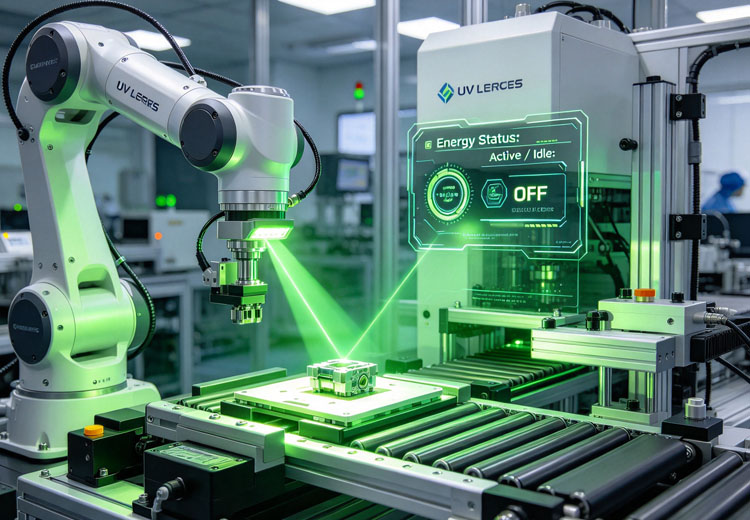
Robotic Integration: In robotic dispensing and curing cells, the UV light can be triggered directly by the robot’s movement. The UV light is active only during the specific bonding and curing phase, maximizing energy efficiency.
The Financial and Operational Impact
Adopting instant on/off technology provides immediate returns:
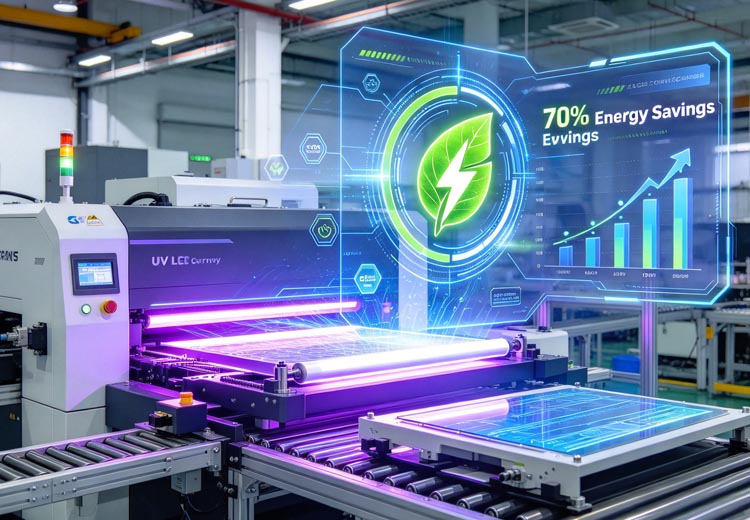
Zero Idle Energy Waste: If the line stops, the UV system stops. You only pay for the electricity used to actually cure a product, reducing curing energy consumption by up to 70% in intermittent processes.
Reduced Ambient Heat: Because the lights are off when not in use, they are not radiating heat into the factory, significantly lowering HVAC cooling costs.
Maximum Equipment Effectiveness (OEE): The UV system is no longer a bottleneck. The production line can start, stop, and change speeds instantly without waiting for the light source to catch up.
In the world of automated manufacturing, synchronization is key. A UV curing system that forces you to run it constantly is a relic of the past. By utilizing instant on/off UV LED technology, manufacturers can achieve perfect harmony between their automation rhythm and their curing process. Turn on when needed, turn off when done—it is the ultimate combination of zero energy waste and maximum production agility.