Low-Temperature UV Curing Process: Bubble-Free, Dense and Void-Free Adhesive Layer
News 2026-09-22
In industrial UV bonding and sealing processes, many manufacturers face a common hidden quality issue: perfect glue lines on the surface, but hidden bubbles, tiny voids and hollow gaps inside the adhesive layer. These invisible defects are the main cause of product water leakage, weak bonding, peeling and poor long-term stability. Most internal glue voids are not caused by glue material problems, but by high-temperature thermal impact during traditional UV curing.
Traditional mercury lamp UV curing produces strong infrared heat while working. When the high-temperature light source irradiates the UV glue layer, the glue temperature rises rapidly in a short time. Thick glue beads, wide sealing paths and stacked glue layers are particularly prone to local overheating. Once the glue temperature is too high, the uncured liquid glue will slightly boil and expand, generating tiny air bubbles. After rapid surface curing, these bubbles cannot escape and remain inside the glue layer, forming hollow holes and porous structures.
These hidden voids seriously reduce product quality. For waterproof sealing products, micro-holes form water vapor penetration channels, causing IP waterproof failure after long-term use. For structural bonding products, hollow glue layers reduce effective bonding area, resulting in insufficient tensile strength and easy cracking under slight vibration or pressure. Batch bubble defects always bring high scrap rates and unstable production quality.
Low-temperature LED UV cold light curing process completely solves the glue bubbling and void problem from the source. Different from heat-dominated mercury lamp curing, LED UV lamps only output effective ultraviolet wavelengths required for glue cross-linking, with almost no infrared thermal radiation. The curing process relies entirely on photochemical reaction rather than high-temperature baking.
During the entire curing process, the glue layer and workpiece maintain a low and stable temperature. There is no sudden temperature spike, no glue boiling and no thermal expansion. The UV adhesive cures slowly and evenly from the surface to the deep layer. Air bubbles in the glue have enough time to discharge completely before the glue layer is fully shaped. The finally formed adhesive layer is dense, solid, uniform and void-free.
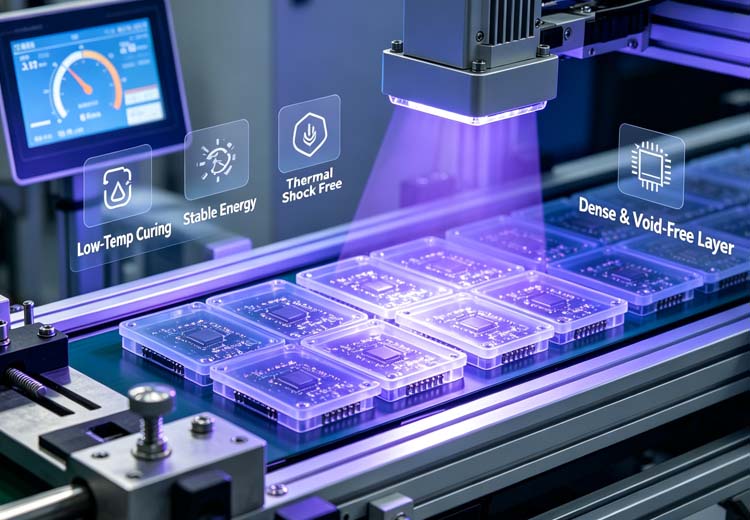
This low-temperature curing advantage is extremely critical for thick glue curing and multi-layer glue sealing. Traditional high-temperature curing inevitably causes surface skinning first, locking internal air and forming large areas of hollow defects. LED low-temperature balanced curing ensures synchronous internal and external curing, completely eliminating pore and bubble defects.
In addition to eliminating bubbles and voids, the low-temperature process also protects sensitive substrates. Plastic shells, thin film materials, electronic components and glass parts will not be deformed, yellowed or thermally stressed during curing. It achieves dual guarantees of stable product appearance and internal bonding quality.
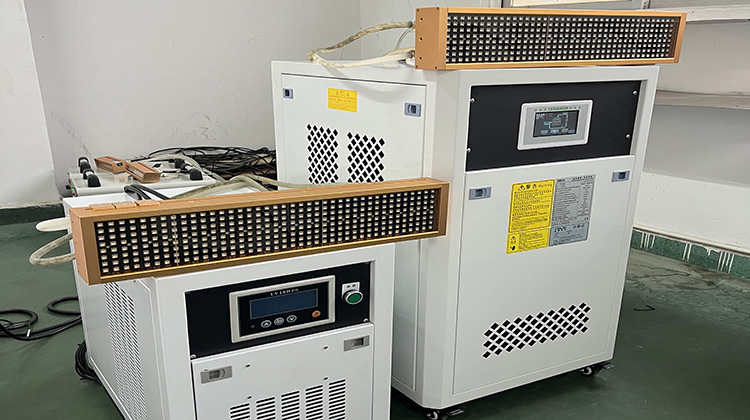
For automated continuous production lines, water-cooled LED UV curing equipment maintains stable low-temperature output for 24-hour long-term operation. No heat accumulation, no energy attenuation, no batch quality difference. Every finished glue line keeps high density, high transparency and high bonding consistency.
In conclusion, low-temperature LED UV curing process is the core solution to solve UV glue bubbling and hollow void defects. It effectively avoids glue overheating foaming, forms dense void-free adhesive layers, greatly improves waterproof performance and bonding strength, and provides stable and reliable quality assurance for 3C electronics, glass assembly and waterproof sealing manufacturing.