Zero Ozone Emission: Creating Odor-Free, Safe, and Eco-Friendly Workshops
News 2026-10-30
Introduction
Walk into any factory using traditional high-intensity UV curing, and you will likely notice a sharp, metallic smell in the air. This is ozone (O3), a highly reactive gas created as a byproduct of the curing process. While it might seem like a minor nuisance, ozone is a serious respiratory irritant and a major compliance issue for environmental, health, and safety (EHS) departments. As industries push for greener and safer operations, the demand for zero ozone emission has become a top priority. UV LED curing technology is leading this charge, providing a clean, odor-free alternative that protects both the workforce and the environment.
Why Do Traditional UV Lamps Produce Ozone?
To understand the solution, we must look at the chemistry of traditional UV curing.
Traditional mercury lamps emit a broad spectrum of UV light, including very short wavelengths—specifically below 240 nanometers (often around 185 nm). When these high-energy short-wave photons interact with oxygen molecules (O2 ) in the ambient air, they split the oxygen molecules into single oxygen atoms. These single atoms quickly recombine with other oxygen molecules to form ozone (O3).
The Result: A continuous generation of ozone gas that requires massive exhaust ventilation to extract from the building.
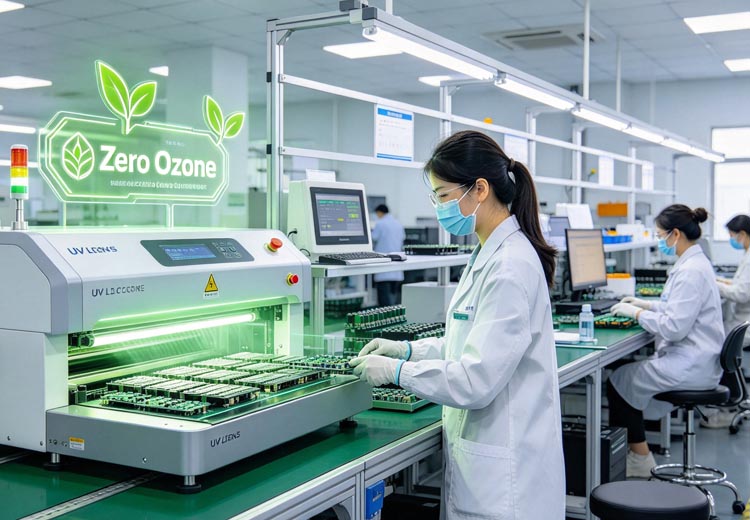
The Hazards of Ozone in the Workshop
Ozone is not just an unpleasant smell; it is a hazard with severe consequences:
Health Risks: According to OSHA and WHO guidelines, prolonged exposure to ozone can cause chest pain, coughing, throat irritation, and severe respiratory issues. It is particularly dangerous for workers with asthma.
Material Degradation: Ozone is a powerful oxidizer. It can degrade rubber components, oxidize metal contacts, and cause discoloration or surface degradation in sensitive plastics and electronics.
Increased HVAC Costs: Extracting ozone requires powerful exhaust fans and air replacement systems, which consume significant amounts of energy and increase facility costs.
Environmental Non-Compliance: Strict environmental regulations limit the amount of ozone that can be released into the atmosphere. Factories must invest heavily to monitor and mitigate these emissions.
The Science of Zero Ozone Emission with UV LEDs
UV LED technology fundamentally solves the ozone problem through its narrow-band spectral output.
No Short-Wave Radiation: High-power industrial UV LEDs typically emit at precise, long wavelengths such as 365 nm, 385 nm, 395 nm, or 405 nm. They do not produce the dangerous 185 nm short-wave radiation required to split oxygen molecules.
Ozone-Free by Design: Because the specific energy required to create ozone is absent, UV LEDs generate absolutely zero ozone. The ambient air remains completely neutral and breathable.
No Odor, No Irritation: Without ozone, the distinct “burning” smell of traditional UV curing disappears entirely. The workshop remains odor-free, creating a vastly more comfortable and safe working environment for operators.
The Business Value of a Green, Odor-Free Factory
Switching to zero-ozone UV LED systems provides immense value beyond just compliance:
Improved Worker Morale and Retention: A clean, odor-free environment improves working conditions and reduces the risk of occupational health claims.
Elimination of Exhaust Ducting: Because there is no ozone to vent, factories can often eliminate massive exhaust pipes and air purification systems, saving on installation and energy costs.
Protection for Sensitive Materials: Zero ozone means no oxidative damage to delicate electronic components, optical lenses, or medical sensors.
ESG and Brand Reputation: Achieving zero emissions demonstrates a commitment to sustainable manufacturing, which is increasingly demanded by global clients and investors.
Manufacturing should not come at the expense of the environment or the health of the people who run the production line. By eliminating the short-wave radiation that produces ozone, UV LED technology turns a hazardous, smelly process into a clean, safe, and odor-free operation. Investing in zero-ozone curing systems is a commitment to environmental responsibility, worker safety, and operational excellence.
Frequently Asked Questions (FAQ)
Q: Why do traditional UV lamps generate ozone?
A: Traditional mercury lamps emit short-wave UV radiation below 240 nm. This high-energy light splits oxygen molecules in the air, which recombine to form ozone (O3).
Q: Are UV LED curing systems completely odor-free?
A: Yes. Because UV LEDs emit specific long wavelengths (e.g., 395 nm) and no short-wave UV, they do not generate ozone. The harsh, metallic odor associated with traditional curing is eliminated.
Q: Do I still need exhaust ventilation with UV LED curing?
A: While general factory ventilation is always recommended for temperature and humidity control, you no longer need specialized, high-power exhaust systems specifically designed to extract toxic ozone.