Factors Affecting Deep Curing of UV Adhesives by LED UV Curing Lamps
News 2026-04-16
In LED UV light curing technology, as a modern curing device, LED UV curing lamps have many significant advantages over traditional UV mercury lamps, including fast curing speed, convenient operation, environmental friendliness and mercury-free properties. However, despite the numerous advantages of LED UV technology, the effect of deep curing of UV adhesives is still affected by multiple factors. This paper analyzes these influencing factors in detail to help optimize the application performance of LED UV curing lamps.
- LED UV Light Curing Energy
The energy of LED UV is the core factor affecting the deep curing effect. The LED UV light source provides the necessary ultraviolet radiation, triggering the photoinitiator to generate free radicals or ions, which further initiate chemical reactions such as polymerization, grafting and crosslinking to achieve curing. Nevertheless, the supply of LED UV energy must be precisely controlled:
Excessive energy: Excessively high LED UV energy may cause energy waste and negative effects during curing, such as implosion or incomplete curing. This not only wastes energy but also compromises product quality.
Insufficient energy: Insufficient LED UV energy may fail to trigger adequate chemical reactions, resulting in incomplete curing. Therefore, the LED UV energy should be reasonably adjusted according to the specific requirements of UV coatings and photoinitiators.
- Thickness of UV Coating
The thickness of the UV coating exerts a critical influence on the curing effect. When the coating is too thick, under a light source of the same power, the curing time will be prolonged accordingly, and may cause excessive surface temperature of the substrate, leading to substrate deformation. Conversely, an overly thin coating may result in poor surface gloss. Thus, the coating thickness should be adjusted based on actual application conditions (such as hue, temperature, curing speed and substrate surface) to achieve an optimal curing effect. - UV Curing Distance
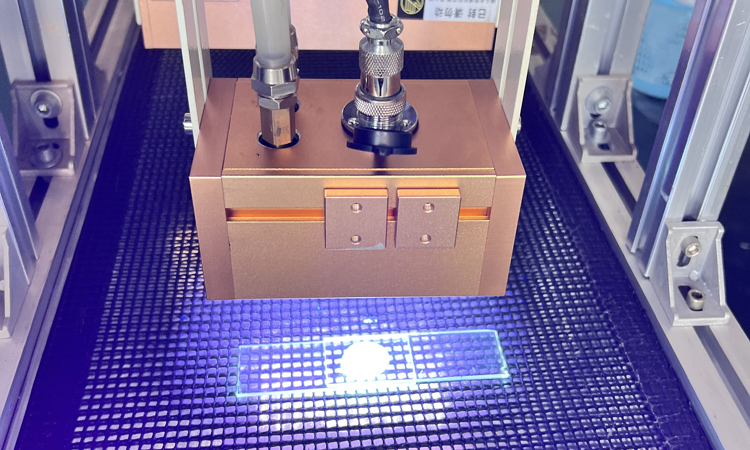
The distance between the LED UV light source and the curing substrate is another key factor affecting the curing effect. Generally, the curing distance should be maintained within the range of 10–15 mm, and the specific distance shall be adjusted according to the substrate type, coating thickness and light source power. An excessively long distance may lead to uneven curing, while an excessively short distance may cause local overheating. - Curing Speed
Adjustment of the curing speed is also crucial to the final outcome. Different substrates and coatings require different curing speeds. An overly fast curing speed may result in surface curing with incomplete internal curing, causing tackiness problems; an overly slow curing speed may lead to aging of the substrate surface. Proper adjustment of the curing speed is essential to ensure complete curing. - Working Environment
The impact of the working environment on UV curing cannot be ignored. The viscosity of UV coatings is affected by changes in ambient temperature, so the ambient temperature should be maintained between 15–25℃. During curing, UV coatings should be protected from direct sunlight to prevent temperature fluctuations from interfering with the curing effect.