Whole-Surface Energy Uniformity: Consistent Cure and Zero Local Defects
News 2026-10-20
Introduction
In high-precision manufacturing, “mostly cured” is not good enough. A product with varying cure levels is a liability. The center might pass a hardness test, while the edges remain tacky, or a shadowed recess might harbor uncured resin. These localized defects often slip past immediate visual inspection but emerge later as field failures. The root cause is usually uneven energy distribution. Achieving whole-surface energy uniformity is the definitive solution. When the UV energy is delivered evenly across the entire product footprint, the result is a consistent cure, predictable performance, and the elimination of localized defects.
The Hidden Cost of Uneven Energy Distribution
When a UV curing system delivers inconsistent energy, it creates a gradient of cure states across the product. Overcured areas may become brittle or suffer from thermal damage, while undercured areas suffer from poor adhesion, low cross-link density, and residual tackiness. This variation is a primary source of localized defects, such as:
Edge Lift and Delamination: Under-exposed perimeters fail to bond properly.
Surface Defects: Uneven irradiance can cause “orange peel” textures, craters, or surface haze.
Hidden Under-cure: Thick or complex parts may be hard on top but soft at the bottom, leading to long-term reliability issues.
To eliminate these defects, the curing process must transition from a “hot spot” approach to a true whole-surface uniformity model.
What Drives Whole-Surface Energy Uniformity?
Achieving uniform energy is not simply about increasing lamp power. It is an engineering challenge that requires balancing several optical and mechanical variables:
Optical Design and Reflectors: The design of the UV reflector is critical. A well-engineered reflector directs light across the entire target area, minimizing hot spots directly under the lamp and preventing dark zones at the edges.
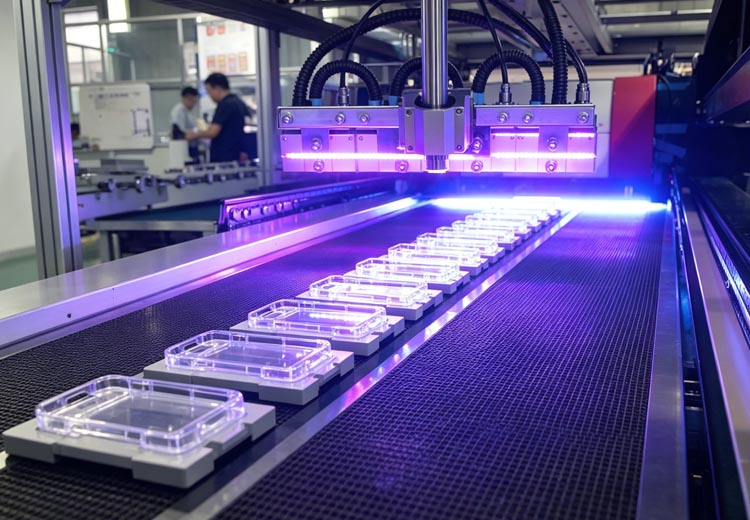
Peak Irradiance vs. Total Dose: Uniformity must be achieved in both peak irradiance (intensity) and total dose (energy over time). If a product moves through a non-uniform light field on a conveyor, the edges may receive a different dose than the center.
Lamp-to-Substrate Distance: Even a high-quality light source can produce uneven energy if placed too close (creating a concentrated center) or too far (causing energy drop-off at the edges).
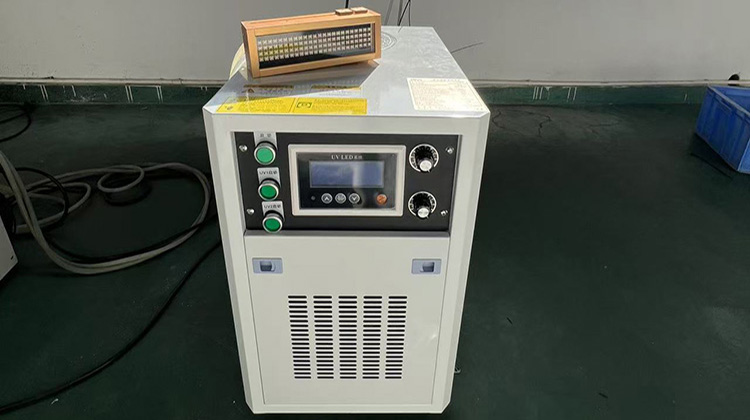
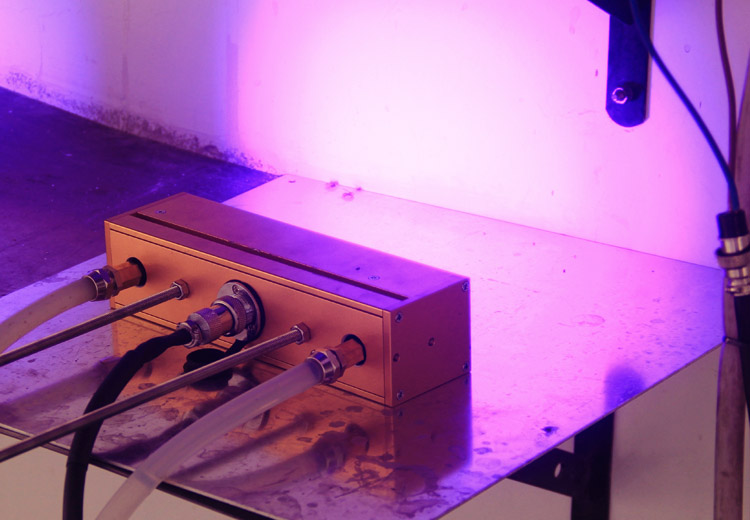
Thermal Management: Localized high energy can create hot spots that cause thermal distortion or cure variations. Uniform cooling systems, like integrated water chillers, help maintain stable process temperatures across the entire surface.
Strategies for Zero Localized Defects
To ensure a consistent cure and eliminate local defects, manufacturers should implement the following strategies:
3D Dose Mapping: Do not rely on a single-point radiometer reading. Map the irradiance and dose across the entire three-dimensional profile of the product. Identify the lowest-energy point and ensure it meets the minimum cure requirement.
Optimize Multi-Angle Exposure: For complex parts, use multi-directional lamps or angled reflector arrays. This ensures that sidewalls and recessed areas receive sufficient energy, preventing shadows from becoming defect zones.
Maintain Strict Process Control: Implement regular maintenance schedules for UV optics. Dust, debris, and degradation of reflectors can cause localized energy drops. Regular cleaning and lamp aging monitoring are essential.
Implement Real-Time Monitoring: Advanced systems can use in-line sensors to monitor irradiance in real-time, automatically adjusting power levels to compensate for lamp degradation or changes in production speed.
Applications in Modern Manufacturing
Whole-surface energy uniformity is critical in industries where precision is non-negotiable. In electronics assembly, uniform curing ensures that conformal coatings provide complete insulation without cracking. In medical device manufacturing, consistent cure of adhesives guarantees sterile and reliable bonds. In automotive and optical components, whole-surface uniformity prevents cosmetic defects and ensures structural integrity. By mastering energy uniformity, manufacturers can dramatically reduce scrap rates and improve throughput.
Conclusion
Consistent cure is not an accident; it is the result of controlled energy distribution. By prioritizing whole-surface energy uniformity, manufacturers can eliminate the localized defects that cause product failure, reduce rework, and build a reputation for uncompromising quality. Moving beyond simple “brightness” to true optical and thermal uniformity is the key to a flawless curing process.
Frequently Asked Questions (FAQ)
Q: What causes localized defects during UV curing?
A: Localized defects are typically caused by uneven energy distribution (hot spots or shadows), improper reflector design, inconsistent lamp-to-substrate distance, or thermal gradients.
Q: How do I measure whole-surface energy uniformity?
A: Use a calibrated radiometer or a dose mapping system to measure irradiance and dose across a grid of the entire product area, not just at the center.
Q: Can water cooling help with energy uniformity?
A: Yes. Excessive heat can cause substrates to distort, altering the distance to the light source. Consistent water cooling maintains stable temperatures, ensuring the cure process remains uniform.