Soft and Uniform Light Source: Achieving Crystal-Clear Adhesive Layers Without Whitening
News 2026-10-22
Introduction
When bonding optical lenses, touch panels, or transparent sensors, the adhesive layer must practically disappear. It needs to transmit light with absolute fidelity, showing no bubbles, no yellowing, and crucially, no whitening or hazing. However, achieving a perfectly transparent cure is challenging. Many manufacturers find that an adhesive that looks crystal clear in its liquid state turns milky or cloudy after UV exposure. The root cause is rarely the adhesive alone; it is usually the curing process. A soft and uniform light source is the key to achieving flawless optical clarity.
Why Does UV Adhesive Turn White or Hazy?
To prevent defects, we must understand their origins. Post-cure whitening and hazing typically stem from three factors:
Uneven Polymerization Shrinkage: High-intensity, uneven UV light cures the top layer instantly while the bottom remains liquid. This creates massive internal stress gradients. As the adhesive shrinks unevenly, micro-cracks or microscopic voids form, scattering light and creating a hazy appearance.
Thermal Degradation and Stress: Concentrated light sources (hot spots) deliver sudden bursts of heat. This rapid thermal expansion and contraction can shock the adhesive chemistry and the substrate, leading to phase separation or micro-fractures that cause whitening.
Incomplete Cross-Linking: If the light fails to penetrate deeply or uniformly, residual unreacted monomers remain. Over time, these monomers may migrate or crystallize, turning the once-clear bond opaque.
The Role of a Soft and Uniform Light Source
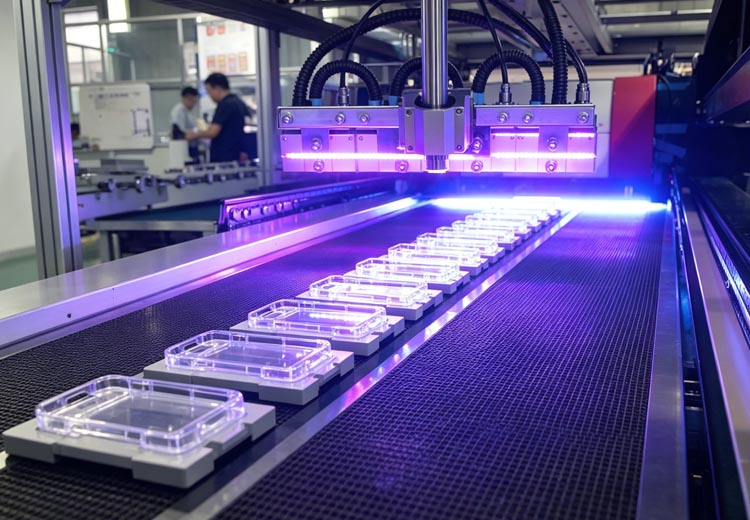
A “soft” light source does not mean low power. It means the energy is delivered without harsh extremes. A soft and uniform light source distributes UV energy evenly across the entire target area, avoiding concentrated hot spots.
Simultaneous Curing: By providing uniform irradiance, the entire depth and footprint of the adhesive begin to cure at the same rate. This minimizes internal stress and prevents the formation of micro-voids.
Thermal Stability: Soft light delivery avoids sudden heat spikes. Paired with efficient cooling systems, it keeps the adhesive temperature stable throughout the exothermic curing reaction, preventing thermal shock.
Oxygen Inhibition Management: Uniform light helps ensure that the surface receives a consistent dose, fully overcoming oxygen inhibition so the top layer cures perfectly clear without a tacky, hazy skin.
Engineering the Perfect Optical Cure
To achieve a clear, non-hazing bond, the curing system must be engineered for precision:
Optical Diffusers: Using specialized diffusers in the light path scatters the UV rays, turning harsh points of light into a broad, gentle illumination field.
Controlled Ramp-Up: Some advanced curing systems allow for a gradual increase in intensity. This slow start allows the adhesive to relax and shrink gradually before reaching full power.
Wavelength Matching: Optical adhesives are often formulated with specific photoinitiators. Using a wavelength that the adhesive absorbs efficiently prevents overexposure while achieving a deep cure.
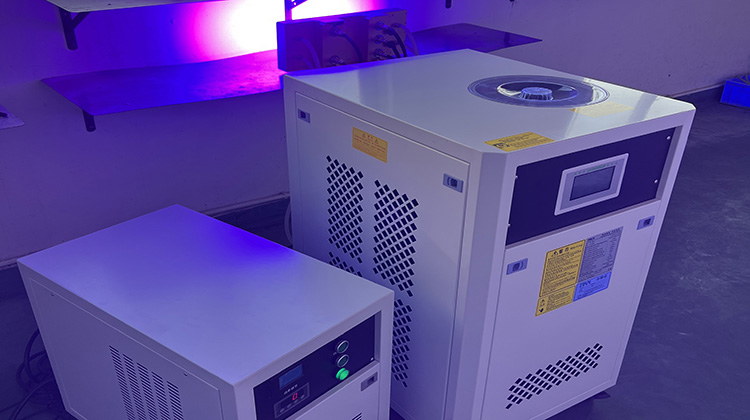
Precise Thermal Management: The curing system must not act as a heater. Integrated water cooling and cold-mirror reflectors ensure that only UV light, not infrared heat, reaches the delicate adhesive.
Applications Where Clarity is Critical
Display Assembly: Optical clear adhesives (OCA) for touchscreens and LCDs require absolute transparency to prevent display cloudiness.
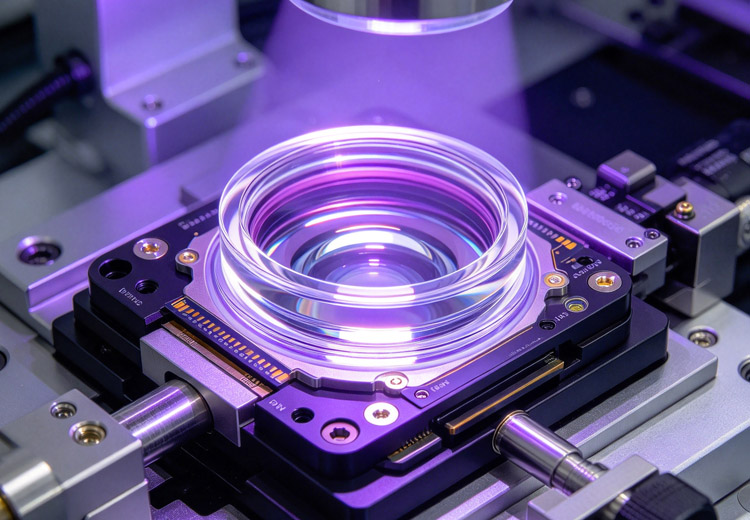
Optical Lens Bonding: Cameras and sensors need clear bonds that won’t distort or scatter light, ensuring high imaging resolution.
Medical Devices: Transparent microfluidic chips and diagnostic sensors rely on clear adhesives for accurate optical readings.
Automotive Lighting: Clear, non-hazing seals protect headlight assemblies from environmental degradation while maximizing light output.
Conclusion
A hazy or whitened adhesive is a defect that cannot be hidden. By moving away from harsh, point-source curing and adopting a soft and uniform light source, manufacturers can eliminate polymerization stress and thermal damage. Uniform illumination ensures that the adhesive cures evenly, deeply, and flawlessly clear. For optical applications, controlling the light is the only way to guarantee a bond that is both structurally strong and visually invisible.
Frequently Asked Questions (FAQ)
Q: Why does my clear UV glue turn white after curing?
A: Whitening is usually caused by uneven curing that creates internal stress and micro-cracks (light scattering), or by excessive heat from the UV lamp damaging the adhesive chemistry. Using a soft, uniform light source prevents this.
Q: Does a softer light source mean longer curing times?
A: Not necessarily. A “soft” light source focuses on uniformity and eliminating hot spots, rather than just lowering power. By delivering even energy across the entire part, it can often cure the adhesive more thoroughly in a single pass.
Q: How do I prevent oxygen inhibition from making the surface hazy?
A: Oxygen inhibition prevents the top layer from curing properly. Ensure uniform UV dose across the surface, or use a nitrogen blanket during curing to displace oxygen.