Instant-On UV Curing: No Warm-Up Time, Maximized Production Efficiency
News 2026-10-26
Introduction
In the modern production line, agility is everything. Whether you are running high-volume packaging, precision electronics, or custom label printing, the ability to start and stop instantly is a competitive advantage. However, traditional UV curing technologies have long been a bottleneck. If a machine requires 5 to 10 minutes to warm up before it can cure adhesives or inks, you are losing time, money, and efficiency. Instant-on UV curing technology changes the rules, offering full power with zero warm-up time and directly boosting your bottom line.
The Hidden Costs of Warm-Up Time
Why is warm-up time such a critical issue? For traditional UV systems like mercury vapor lamps, the bulb must heat up the mercury until it vaporizes to emit UV light. This creates several costly side effects:
Wasted Downtime: Operators must start the machine and wait 5-10 minutes before running the first product. Over a year, this adds up to dozens of lost production hours.
High Scrap Rates: If you start production before the lamp reaches full stability, the first few meters of product will be undercured and must be thrown away.
Disrupted Job Changes: In a multi-variety, low-volume environment, stopping to wait for a lamp to warm up kills the momentum of quick job changes.
Energy Waste: Lamps left running continuously to avoid warm-up delays consume massive amounts of electricity, even when no product is being cured.
How Instant-On Technology Works
Instant-on UV curing is made possible by UV LED (Light Emitting Diode) technology. Unlike mercury lamps that require physical heating, UV LEDs are semiconductor devices.
Immediate Emission: When electrical current is applied, the LED chip emits UV light instantly. There is no filament to heat, and no gas to ionize.
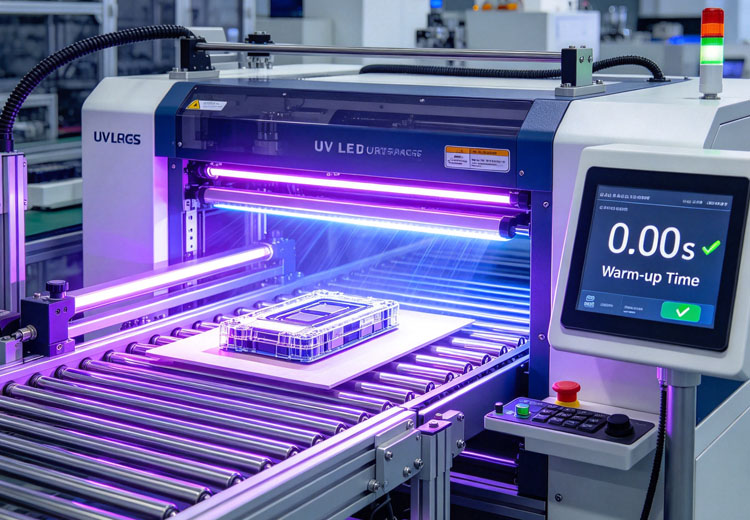
Full Power at the Push of a Button: Advanced power supplies can deliver 100% peak irradiance in microseconds. The curing effect is fully stable from the very first second.
Zero Cool-Down Required: Mercury lamps must cool down before restarting, or they can shatter or fail. UV LEDs can be switched on and off repeatedly, thousands of times a day, without any damage or delay.
Boosting Production Efficiency in Real-World Scenarios
Adopting instant-on technology directly transforms production efficiency:
Maximizing OEE (Overall Equipment Effectiveness): By eliminating the warm-up waiting phase, machines run closer to their theoretical maximum capacity.
On-Demand Curing: You can turn the UV system off during product gaps, breaks, or material reloading. When the conveyor moves, the light turns on instantly. This drastically reduces energy consumption.
Seamless Rapid Job Changes: When switching from a light-colored label to a dark, thick ink job, the UV system is ready immediately. No more waiting for the lamp to stabilize.
Protecting Heat-Sensitive Substrates: Because the system is only on when the product is directly under it, there is no residual heat radiating onto the materials during idle periods.
Are There Any Compromises in Curing Quality?
Absolutely not. In fact, curing quality often improves. Mercury lamps suffer from “thermal droop” and take time to reach optimal spectral stability. Instant-on UV LED systems deliver a highly consistent, precise wavelength the moment they fire. When paired with closed-loop control and uniform optics, they provide a more reliable and repeatable cure than legacy systems.
Conclusion
In manufacturing, time is literally money. The “wait and see” era of mercury lamps is over. By switching to instant-on UV curing, you eliminate the invisible delays that throttle your throughput. With no warm-up time, zero cool-down requirements, and immediate full-power output, you are not just saving a few minutes per shift—you are unlocking a new level of manufacturing agility and efficiency.
Frequently Asked Questions (FAQ)
Q: Why do traditional UV lamps require a warm-up time?
A: Traditional mercury lamps rely on heating liquid mercury until it vaporizes into a gas to emit UV light. This physical heating process takes several minutes before the light output stabilizes.
Q: Can I turn an instant-on UV LED system on and off frequently?
A: Yes. Unlike mercury lamps, which can be damaged by frequent on/off cycles, UV LEDs can be switched on and off thousands of times a day without degrading their lifespan.
Q: Does instant-on UV curing save energy?
A: Absolutely. Because there is no need to keep the lamp idling at full power during breaks or downtime, energy is only consumed when curing is actively taking place.