How Switching to an Air-Cooled LED UV Lamp Fixed a Conveyor Glue Curing Bottleneck for an Electronics Plant
News 2026-11-27
On high-speed electronics assembly lines, getting UV adhesives to cure reliably right after dispensing is often harder than it looks on paper. When parts move continuously down a belt, engineers have to balance two conflicting demands: delivering enough UV energy to cure thick adhesive dots all the way through, while keeping heat low enough to avoid warping sensitive plastic housings or damaging micro-chips.
Earlier this year, our engineering team at Youjiete Optoelectronics worked with a precision sensor manufacturer facing this exact issue. By retrofitting their existing conveyor line with our CT5-300 Air-Cooled LED UV Curing Lamp, the facility eliminated thermal rejects and pushed daily output up by 70%—without tearing up their floor plan for water chiller piping.
The Setup: Automated Dispensing on a Tight Conveyor Line
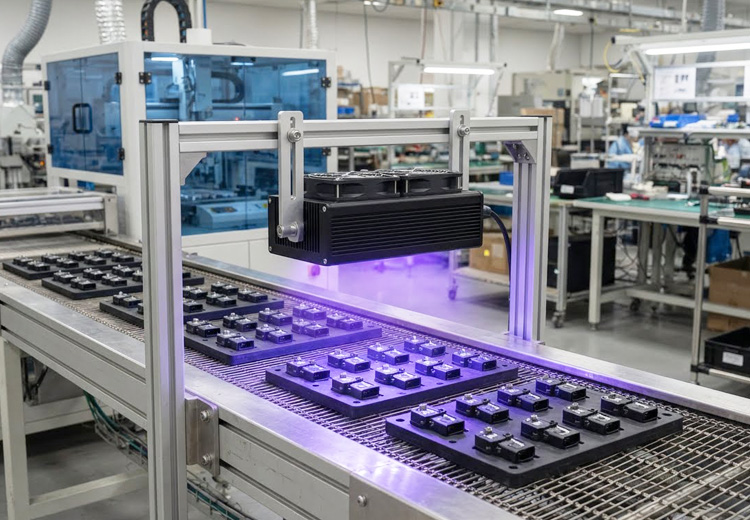
The client manufactures compact automotive and industrial sensors. Their line runs a straightforward sequence: an automated valve dispenses a high-viscosity structural UV adhesive into a plastic-and-metal housing, and the tray moves straight onto a mesh conveyor belt that passes under a curing station.
For years, they relied on a standard hooded mercury vapor UV system. As order volumes grew and they tried speeding up the belt, three problems brought the line to a crawl:
- Zero Room for Water Chillers: The workshop runs parallel, tightly packed conveyor lines. There was simply no floor space or overhead clearance to route water pipes or install bulky external chillers. They needed a self-contained, air-cooled lamp head that could bolt directly onto their existing aluminum gantry.
- Heat Warping Thin Housings: Mercury bulbs throw off intense infrared radiation. Even with exhaust ducting, surface temperatures on the sensor housings regularly spiked past 85°C. That heat caused subtle warping around the snap-fit joints and stressed internal solder points, leaving their first-pass yield stuck around 89.5%.
- Uncured Adhesive at the Bottom of Deep Cavities: In several sensor models, the dispensed UV glue sits 2.5mm deep inside a narrow groove. At normal belt speeds, the broad-spectrum mercury lamp cured the top skin of the glue, while the bottom stayed tacky—leading to inconsistent pull-test failures during QC checks.
Why Air-Cooled LED UV Made Sense Here
Instead of redesigning the conveyor or slowing down the dispensing robots, we recommended dropping a 395nm Air-Cooled LED UV Curing System right over the belt, 15mm above the passing trays.
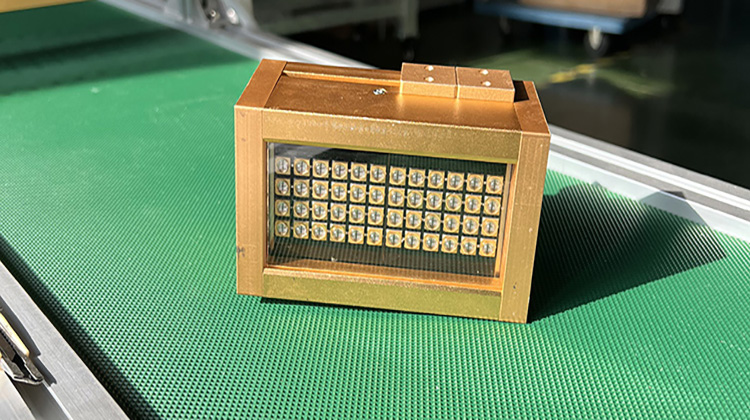
- Plug-and-Play Air Cooling: The CT5-300 uses a machined aluminum fin heatsink paired with high-static-pressure industrial fans. It pulls heat straight off the LED array and exhausts it upward, keeping the conveyor zone below 40°C. Installation took less than two hours during a scheduled shift change.
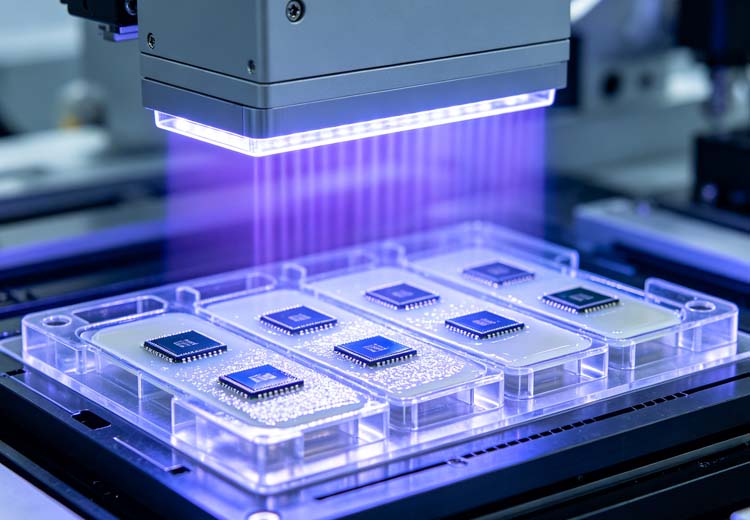
- Deep Penetration at 395nm: Built with genuine Seoul Semiconductor UV LED chips, the lamp concentrates its output tightly around 395nm. Because this wavelength matches the photoinitiators in their structural acrylic adhesive far better than scattered mercury light, UV energy penetrates straight to the bottom of the 2.5mm glue cavity. A 1.2-second pass under the lamp now achieves full cross-linking from top to bottom.
- Uniform Coverage Across the Belt: With parts lined up four-across on each conveyor tray, edge drop-off was a concern. Our quartz optical lens design keeps irradiance uniformity above 92% across the full 300mm curing width, so parts on the outer edges of the belt get the exact same dose as parts in the center.
- PLC Trigger Integration: Powered by a Mean Well constant-current driver, the unit wired directly into the conveyor’s PLC. When the belt pauses or no trays are detected, the LEDs switch off instantly—cutting idle power waste and eliminating the 15-minute warm-up wait they hated about mercury lamps.
Side-by-Side Line Results After 30 Days
Once the retrofit went live, the plant’s quality team tracked production data over a full month of two-shift operation. Here is how the numbers stacked up against their old mercury setup:
| Production Metric | Previous Mercury UV Hood | Youjiete Air-Cooled LED UV (CT5-300) | Measured Change |
|---|---|---|---|
| Cure Time (2.5mm Glue Depth) | 4.0 seconds (tacky base) | 1.2 seconds (100% cured) | 3.3x faster cure cycle |
| Conveyor Belt Speed | 1.5 m/min | 2.6 m/min | +73% line speed |
| Daily Output (Single Line) | 12,000 units | 20,400 units | +70% capacity gain |
| Peak Part Surface Temp | 85°C – 92°C | < 40°C | Thermal scrap cut by 94% |
| Pull-Test QC Pass Rate | 89.5% | 99.8% | Consistent bond strength |
| Power Draw | 5.5 kW (continuous) | 1.2 kW (on-demand) | 78% energy savings |
Looking to Speed Up Your Dispensing Line?
If your production line runs automated UV glue dispensing over a conveyor, heat buildup and slow belt speeds don’t have to be part of the job. Upgrading to a compact air-cooled LED UV curing lamp lets you keep your existing conveyor layout while curing deeper, faster, and cooler.
At Youjiete Optoelectronics, we build custom air-cooled and water-cooled LED UV curing lamps (CT3, CT4, CT5, and CT10 series) tailored to your exact conveyor width, working distance, and adhesive chemistry. Every system is backed by a 2-year warranty and direct support from our engineering team.
Want to verify how fast your UV adhesive cures under our lamps? Send us a sample of your glue and substrate, or reach out to our team at uvcuringlamp.com for a free curing test and irradiance recommendation.