Eyeglass Temple Screen Printing | Water-Cooled LED UV Curing Lamp Improves Ink Adhesion on Electroplated Plastic Parts and Speeds Up Curing
News 2026-11-23
Project Information
| Item | Details |
| Contact Person | Factory Manager Zhou |
| Factory Address | Danyang, Jiangsu, China |
| Company Type | Eyeglass parts screen printing factory |
| Number of Employees | About 80 people |
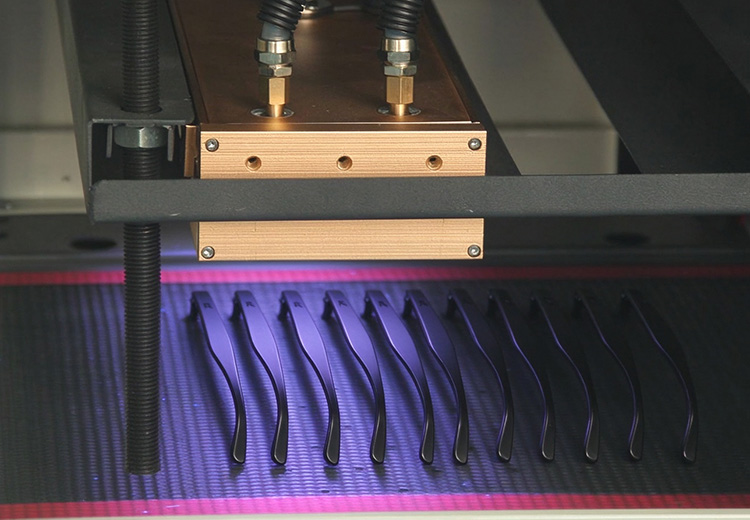
| Main Products | UV screen printing of logos and text on plastic electroplated eyeglass temples |
| Downstream End Customers | Eyeglass brands, eyeglass manufacturers, foreign-trade eyeglass buyers |
| Core Process Involved | Loading electroplated temples → Automatic UV screen printing → UV curing → Unloading inspection |
| Ink Used | UV screen printing ink (special for electroplated surfaces), light absorption peak in the 395nm UVA band |
| Printing Substrates | ABS/PC plastic electroplated parts (vacuum chrome-plated, titanium-plated layers) |
| Curing Equipment Before Retrofit | Conventional high-pressure mercury lamp |
| Production Line Configuration | Semi-automatic screen printer + inline curing lamp |
| Line Speed Before Retrofit | 1200 pieces/hour |
| Target Line Speed | ≥2000 pieces/hour |
| Workshop Conditions | Room-temperature screen printing workshop, constant temperature 23±3℃ |
| Core Pain Points Before Retrofit | 1. The electroplated surface is smooth and highly inert; ink adhesion is poor and ink peels off in the 3M tape test 2. Slow mercury lamp curing limits printing speed; a clear capacity bottleneck 3. High infrared heat from the mercury lamp oxidizes, clouds, and discolors the plating at high temperature 4. Short tube life (800~1000h), frequent shutdowns for replacement, high consumable cost 5. Strong ozone odor; high exhaust load in the screen printing workshop |
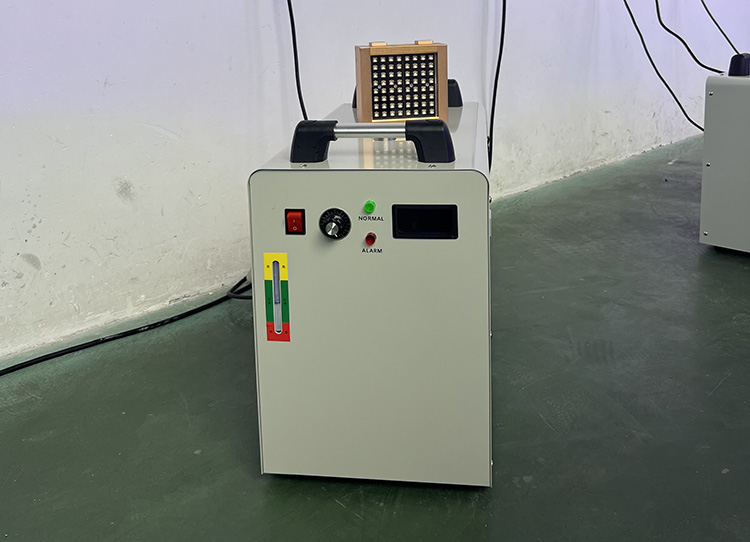
| Selected Equipment Model | YJT-CT2-200A water-cooled LED UV curing lamp |
| Working Wavelength | 395 nm |
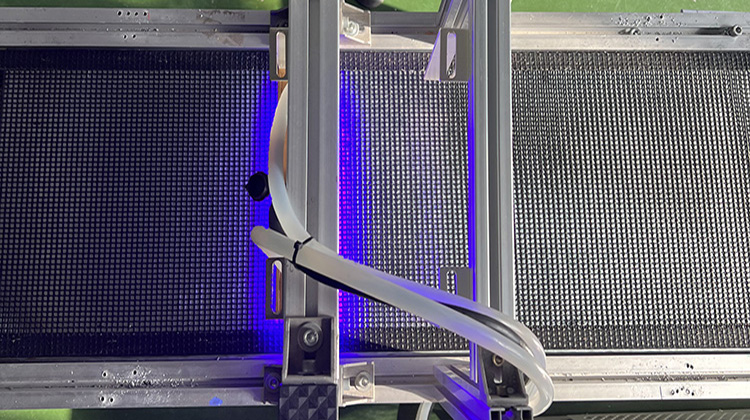
| Installation Method | Inline type; customized linear emitting surface adapted to multiple temples printed side by side |
| Customer Acceptance Criteria | 1. Ink on the electroplated surface passes the 3M tape test with 100% no ink peeling 2. Plating free of oxidation, clouding, or discoloration 3. Curing speed meets ≥2000 pieces/hour 4. Instant on, no warm-up required 5. No ozone generated |
| Reliability Test Standards | 3M 610 tape peel test; RCA alcohol rub test (500g load); adhesion retest after 48℃/95%RH 24h damp heat |
| Project Timeline | Sample proofing confirmation: 2 working days Equipment delivery + on-site installation and commissioning: 5 working days |
| Expected Benefits for the Customer | Improved printing yield, higher line speed, protection of the plating appearance, and savings on tube consumables and electricity |
1. Project Background
The customer is located in Danyang, Jiangsu, with Factory Manager Zhou as the contact person. Danyang is China’s eyeglass capital: about 70% of the country’s lenses and more than 50% of its frames are made here, and the eyeglass parts processing supply chain is highly concentrated. The factory has about 80 employees and specializes in UV screen printing of logos and text on plastic electroplated temples, serving domestic eyeglass brands and foreign-trade buyers. The line uses an automatic screen printer to print brand markings on ABS/PC plastic temples with vacuum chrome or titanium plating.
Before the retrofit, the curing equipment paired with the printer was a conventional high-pressure mercury lamp. Production faced three core problems. First, the electroplated surface is smooth and chemically inert; bonding UV screen printing ink to a plated surface is itself an industry challenge. The broad-spectrum mercury lamp disperses its energy, and when curing is insufficient the ink crosslinks inadequately, so ink peels off at the first pull of the 3M tape; the printing defect rate had long stayed high. Second, the mercury lamp cured slowly; to guarantee basic curing the printing speed had to be lowered, restricting capacity and creating heavy pressure to deliver rush orders in peak season. Third, the mercury lamp emits strong infrared heat; after temples pass through the curing furnace the plating temperature can exceed 70℃, and high temperature oxidizes, clouds, and mottles the vacuum plating. Haze marks appear on the once-bright temple surface, and plated parts are scrapped directly; such losses account for more than 40% of all plating-printing defects. In addition, the mercury lamp required more than 5 minutes of warm-up, and the tube needed replacement after about 800~1000 hours of decay; frequent shutdowns disrupted continuous production. The ozone odor was especially noticeable in the enclosed printing workshop, and the exhaust system ran at high load year-round. The customer urgently needed to speed up curing, while stably improving ink adhesion on the plating and protecting the plating from heat damage.
2. Solution Selection
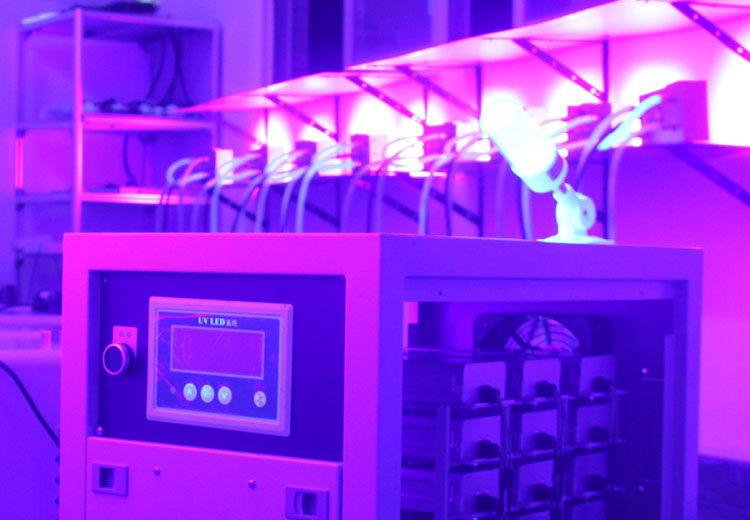
The customer sent samples to our company for curing testing. Taking into account the characteristics of the electroplated plastic substrate, the absorption curve of the plating-special UV screen printing ink, the slender shape of the temples, and the side-by-side arrangement, we recommended a water-cooled LED UV curing lamp. The 395nm wavelength was chosen to precisely match the photoinitiator absorption peak of the plating-special UV screen printing ink. According to the side-by-side arrangement of multiple temples, a 200mm emitting surface was custom-made to ensure even intensity coverage of the printing area on each row of temples; UV energy is continuously adjustable from 0~100%, with a 30% power margin reserved for curing inks of different colors and plating layers of different thicknesses. A light shield was fitted, and the unit interfaces with the printer PLC so the light source starts and stops in sync with printing. Water cooling keeps light intensity stable without decay during long continuous production; the cold light source keeps the temple surface temperature below 40℃, fundamentally avoiding high-temperature oxidation and clouding of the plating.
3. Proofing Tests and Comparative Data
During the preliminary free proofing stage, side-by-side comparison tests were conducted using the same vacuum chrome-plated temples, the same black UV screen printing ink, and the same workshop conditions, focusing on curing speed, ink adhesion on the plated surface, and plating appearance changes. The test results are shown in the table below:
| Test Item | Unit | Mercury Lamp Solution | YJT-CT2-200A Water-Cooled LED UV Curing Lamp | Test Basis |
| Rated Power | W | 400 | 600 | Product Specification |
| Peak Energy | mW/cm² | 300~380 | 9000~11000 | Measured with UV radiometer |
| Working Distance | mm | 100~150 | 30~50 | Production Setting |
| Curing Time | s | 3~5 | 0.5~1.0 | Appearance + 3M tape test |
| Warm-up Waiting Time | s | 300~360 | 0 (instant on) | On-site production line record |
| Energy Required for Full Curing | mJ/cm² | 500~600 | 180~220 | Measured with UV radiometer |
| 3M Tape Peel Ink Peeling Rate | % | 12~18 | 0 (no ink peeling) | 3M 610 tape, 500 pieces per batch |
| RCA Alcohol Rub (500g) | cycles | 80~120 | 300~400 | Alcohol rub tester |
| Plating Appearance (oxidation/clouding) | — | Noticeable clouding and mottling | No change, bright as new | Visual inspection + gloss meter |
| Temple Surface Temperature | ℃ | 70~85 | 35~40 | Infrared thermometer |
| Overall Screen Printing Defect Rate | % | 8.5~12.0 | 0.8~1.5 | Statistics over 5,000 consecutive pieces |
| Printing Capacity | pieces/hour | 1200 | 2200 | On-line measurement |
4. Implementation and Project Results
After proofing verified curing speed, ink adhesion on the plated surface, and that the plating appearance was normal, the solution was confirmed and the linear-emitting lamp head was custom-produced. After delivery, our technicians installed and wired the equipment on site, and commissioned it; we also trained operators on equipment operation as well as daily maintenance of the water circuit and lamp surface. The complete unit comes with a two-year warranty, and after-sales engineers respond quickly to production line issues.
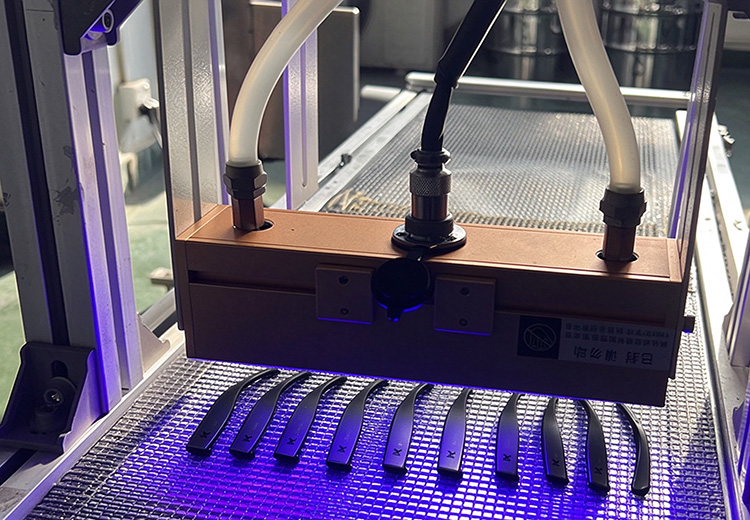
The following results were achieved after entering mass production:
1. Curing speed improved markedly; printing capacity rose from 1200 pieces/hour to 2200 pieces/hour, doubling capacity and clearly easing rush-order pressure in peak season;
2. Ink on the plated surface is fully cured; the 3M tape peel test shows a 0% ink peeling rate, and RCA alcohol rub improved from 80~120 cycles to 300~400 cycles, with adhesion stably meeting the standard;
3. Cold-light low-temperature curing lowered the temple surface temperature from 70~85℃ to 35~40℃; the plating has no oxidation, clouding, or discoloration, and the plating scrap rate dropped sharply;
4. The overall screen printing defect rate dropped from 8.5%~12.0% to 0.8%~1.5%; based on a monthly output of 300,000 temples, about 25,000 fewer defective pieces are produced each month;
5. The light comes on instantly with no warm-up required, suiting continuous automatic screen printing, with flexible changeover and setup;
6. Compared with the traditional mercury lamp, it saves about 75% of electricity; the light source lasts 20000~30000 hours, eliminating capacity losses from frequent tube purchasing and downtime replacement;
7. No ozone is generated, the pungent odor in the screen printing workshop is eliminated, and the exhaust load is reduced.
If your production line also suffers from slow curing, unstable adhesion, or heat damage to plated parts, please feel free to contact us. We accept sample curing tests and provide test reports with measured data. Custom fixtures and energy adjustment services are available.