Constant UV Energy Without Attenuation: Ensuring High Batch-to-Batch Consistency
News 2026-10-23
Introduction
In modern manufacturing, yield is not just about producing a good first part; it is about producing millions of identical, flawless parts over months and years. However, UV curing is highly sensitive to energy variations. A slight drop in UV intensity can mean the difference between a robust bond and a catastrophic field failure. When UV energy attenuates—whether due to lamp aging, heat, or dirt—batch-to-batch consistency collapses. Achieving constant UV energy without attenuation is the cornerstone of repeatable, high-quality mass production.
Why Does UV Energy Attenuate?
To solve the problem, we must identify the sources of energy loss. In a typical UV curing system, attenuation occurs due to four main factors:
Light Source Degradation: UV LEDs naturally degrade over time (lumen depreciation), and mercury lamps lose intensity as the bulbs age.
Thermal Droop: As LEDs heat up during operation, their light output efficiency drops. Without robust cooling, energy delivery becomes unstable.
Optical Contamination: Dust, ink mist, and outgassing from adhesives can slowly coat the quartz glass and reflectors, blocking UV light from reaching the substrate.
Power Supply Fluctuations: Unstable electrical input can cause the UV driver to deliver inconsistent power to the lamp.
The Core Technologies for Zero Attenuation
To guarantee batch-to-batch uniformity, modern UV curing systems employ several key technologies:
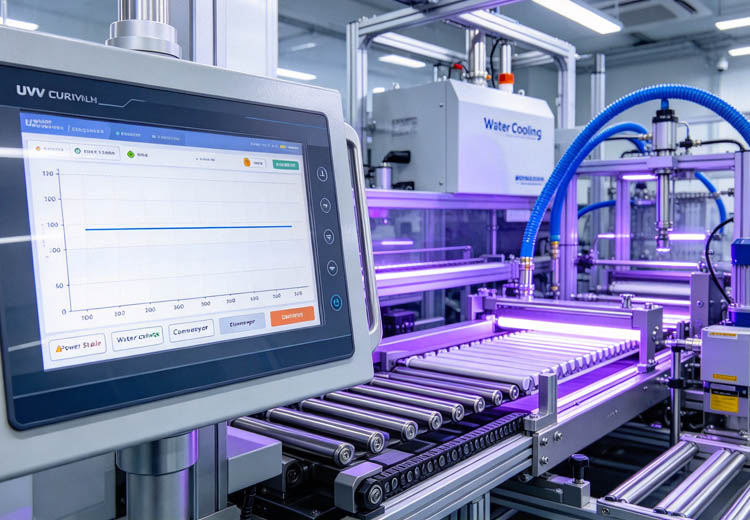
Closed-Loop Feedback Control: This is the most critical feature. Sensors monitor the actual UV output in real-time. If the light intensity drops due to heat or aging, the system automatically increases the electrical current to maintain a constant, exact energy output.
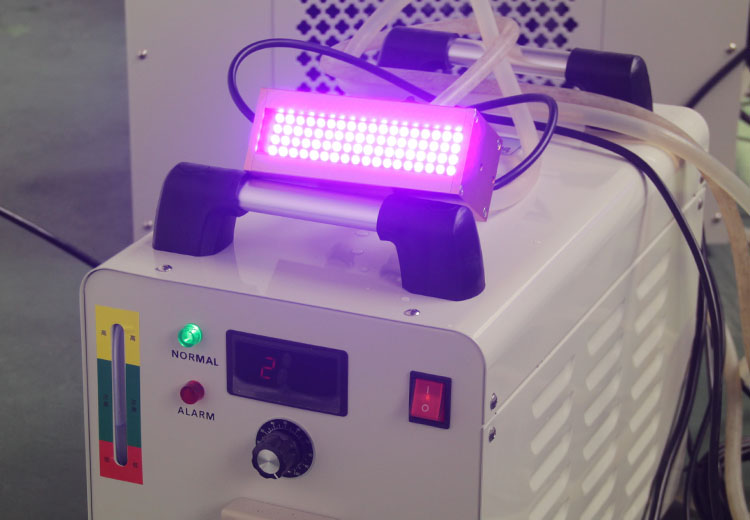
Advanced Thermal Management: Integrated water-cooling systems and efficient heatsinks maintain stable LED junction temperatures. This eliminates thermal droop, ensuring the light source performs consistently from the first second of the shift to the last.
Constant Current Drivers: High-quality power supplies ensure that the electrical current reaching the LED array remains stable, regardless of external power grid fluctuations.
How Constant Energy Equals Uniform Quality
When energy is strictly controlled, the curing process becomes a fixed, repeatable chemical reaction.
Predictable Cross-Linking: A constant dose of UV energy ensures that the polymer network reaches the exact same degree of cross-linking in every batch. This guarantees identical physical properties, such as hardness, adhesion, and chemical resistance.
Elimination of Human Error: Operators no longer need to manually adjust the curing speed or lamp power to compensate for a weakening bulb. The system self-regulates, removing human variance from the equation.
Process Lock-In: Once the ideal curing parameters are found, a constant-energy system “locks in” that performance. The 1st part, the 10,000th part, and the 1,000,000th part will all be cured exactly the same way.
Monitoring and Maintenance for Long-Term Stability
Even with the best technology, real-world variables exist.
Real-Time Radiometry: Built-in sensors should continuously log the irradiance and dose. If the system needs to push the LEDs beyond a safe threshold to maintain energy (due to severe optical contamination), it should trigger an alert for maintenance.
Scheduled Optics Cleaning: Keeping the quartz glass and reflectors clean is vital. A consistent maintenance schedule ensures that the closed-loop system does not overwork itself trying to compensate for physical blockages.
Data Logging: Modern Industry 4.0 curing systems log the energy output for every single batch. This provides traceability. If a defect is found weeks later, engineers can check the logs to prove the UV energy was perfectly constant during that production run.
Conclusion
Consistency is the ultimate goal of manufacturing. By implementing closed-loop control, advanced cooling, and stringent monitoring, manufacturers can achieve constant UV energy without attenuation. This eliminates batch-to-batch variations, secures product reliability, and ensures that the quality of your output is as unchanging as the light that cures it.
Frequently Asked Questions (FAQ)
Q: Why is batch-to-batch consistency difficult in UV curing?
A: UV lamps degrade over time, generate heat, and their optics get dirty. If the system does not compensate for these changes, the UV dose drops, leading to inconsistent cure levels between the first and later batches.
Q: How does a closed-loop UV system work?
A: A closed-loop system uses sensors to measure the actual UV output. If the output drops due to aging or heat, the controller automatically increases power to maintain a constant, exact energy level.
Q: Can I just increase the curing time to make up for attenuation?
A: While increasing time adds dose, it often changes the thermal profile of the process and can overheat the substrate. It is much better to maintain constant peak irradiance and dose through active control.