UV Curing: Empowering High-Efficiency and Eco-Friendly Technology in the New Energy Sector
News 2025-11-25
UV curing technology, with its advantages of rapid curing, low energy consumption, and solvent-free volatilization, is becoming a key support for cost reduction, efficiency improvement, and green development in the new energy industry, achieving in-depth applications in fields such as photovoltaics and lithium batteries.
In the photovoltaic sector, UV curing is widely used in component encapsulation and structural fixation: for the bonding of photovoltaic glass and backsheet, as well as the curing of frame sealant, UV technology can reduce curing time from several hours in traditional processes to the minute level. Moreover, the cured adhesive layer exhibits excellent resistance to high and low temperatures and anti-UV aging, ensuring long-term stable power generation of components outdoors.
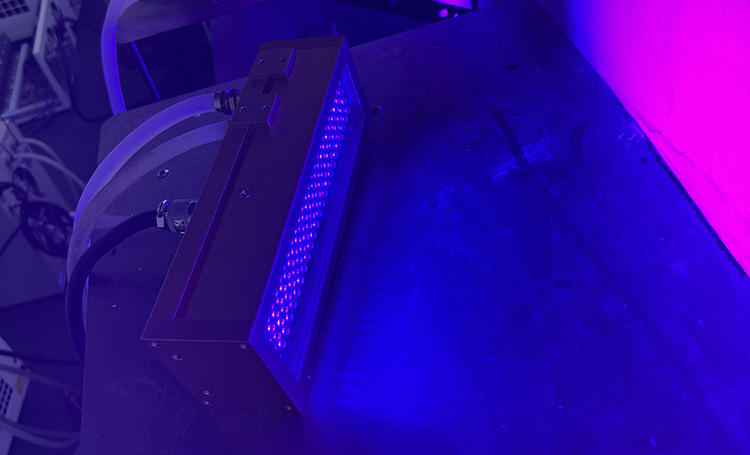
In lithium battery production, UV curing addresses the energy consumption pain points of traditional high-temperature curing: during electrode manufacturing, UV adhesives can cure rapidly at room temperature, reducing damage to electrode materials caused by high temperatures. In the sealing process of battery casings and tabs, UV adhesives can quickly form an insulating protective layer, enhancing the safety and efficiency of battery production.
In the hydrogen energy field, UV curing contributes to the performance upgrading of fuel cells: in processes such as conductive coating on bipolar plate surfaces and encapsulation of proton exchange membranes, UV curing technology can precisely control coating thickness, with light intensity uniformity reaching 90%. This enhances the corrosion resistance and conductivity of bipolar plates, providing support for the mass production of fuel cells.
UV curing technology is driving the new energy industry toward more efficient and environmentally friendly development by adapting to its core needs.