Self-Adhesive Label Printing | LED UV Curing Lamp Retrofitted on a Label Press to Solve Film Label Heat-Stretching Issues
News 2026-11-17
Project Information
| Item | Detailed Information |
| Contact Person | Mr. Wang |
| Factory Address | Xi’an, Shaanxi, China |
| Company Type | Professional self-adhesive label printing factory |
| Number of Employees | About 120 people |
| Main Products | Self-adhesive labels for daily chemical and food products; UV ink curing for PET/PP film labels |
| Downstream End Customers | Brand customers in personal care, food & beverage, wine & spirits, and pharmaceutical packaging |
| Core Process Involved | Printing → UV ink curing → Die-cutting and waste stripping → Finished-product inspection |
| Ink Used | LED-dedicated UV offset ink, with light absorption peak in the 395nm UVA band |
| Printing Substrates | PET film, PP synthetic paper, coated paper |
| Curing Equipment Before Retrofit | Conventional high-pressure mercury lamp |
| Production Line Configuration | Printing press + inline curing |
| Line Speed Before Retrofit | 60 m/min |
| Target Line Speed | ≥80 m/min |
| Workshop Conditions | Room-temperature printing workshop, constant temperature 23±3℃ |
| Core Pain Points Before Retrofit | 1. Heavy infrared heat radiation from the mercury lamp causes PET/PP film to stretch and wrinkle under heat 2. Large registration deviation and a persistently high reject rate 3. Dark solid ink is not fully cured, leading to color fading 4. The lamp tube requires a long warm-up, cannot be started/stopped frequently, and decays quickly 5. Strong ozone odor and high maintenance costs for the exhaust system |
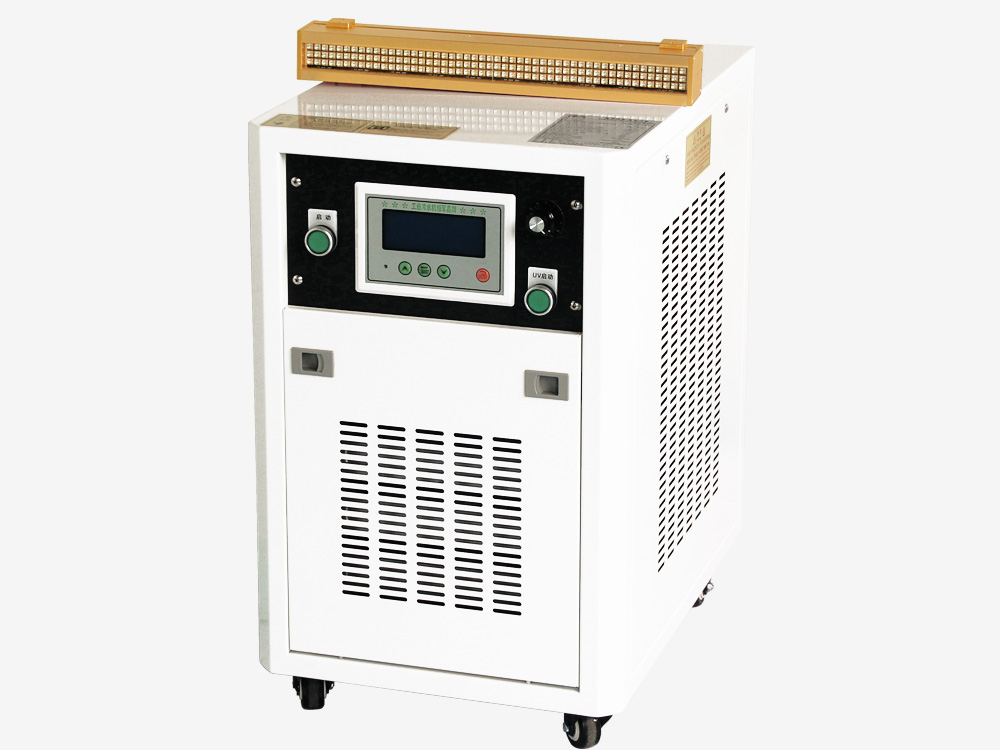
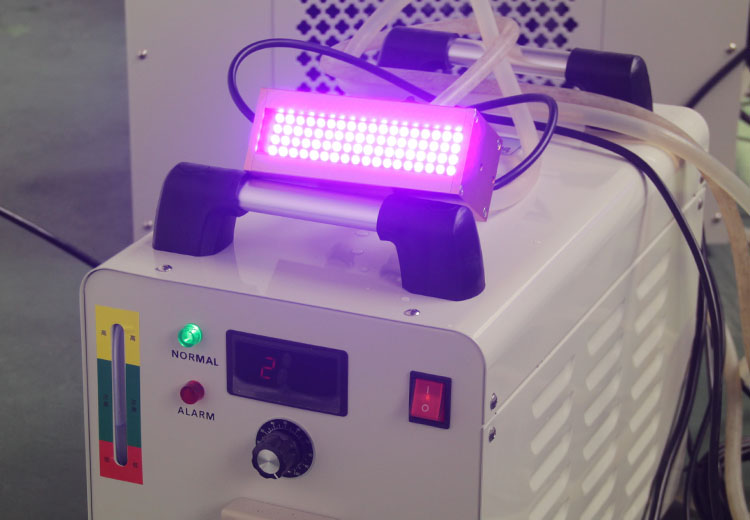
| Selected Equipment Model | YJT-CT3-200A water-cooled LED UV curing system |
| Working Wavelength | 395 nm |
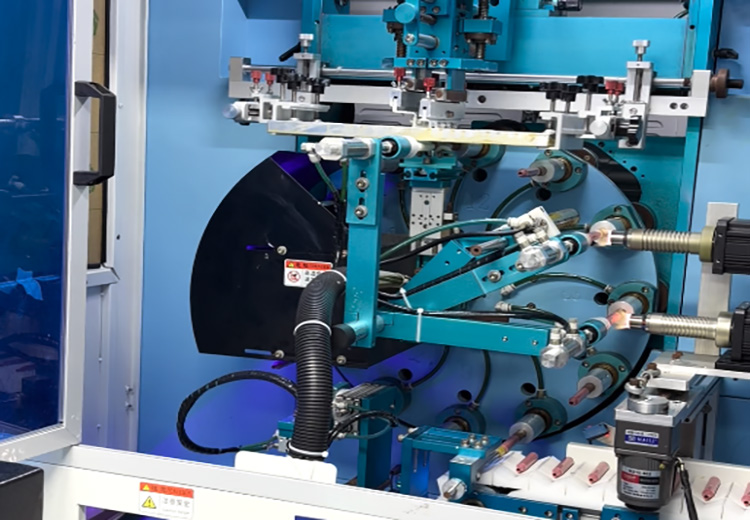
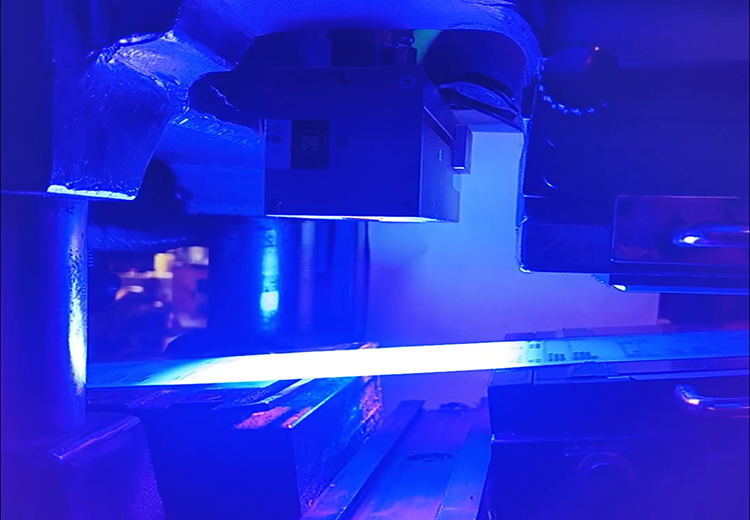
| Installation Method | Inline type; customized linear light-emitting face aligned to the curing station of the label press |
| Customer Acceptance Criteria | 1. No stretch deformation of film substrates 2. Dark solid ink fully cured without color fading 3. Stable registration accuracy 4. Instant on, no warm-up required 5. No ozone generated; improved workshop environment |
| Reliability Test Standards | ink adhesion test; 3M tape peel test; label scratch resistance test |
| Project Timeline | Sample proofing confirmation: 3 working days Equipment delivery + on-site installation and commissioning: 7 working days |
| Expected Benefits for the Customer | Lower film label reject rate, improved registration accuracy, savings on tube replacement and electricity costs, and an improved workshop environment |
1. Project Background
The customer is located in Xi’an, Shaanxi, with Mr. Wang as the contact person. The factory has about 120 employees and is a professional printing enterprise in Northwest China specializing in self-adhesive labels for daily chemical, food & beverage, and pharmaceutical packaging. As a central city of the printing and packaging industry in Northwest China, Xi’an is surrounded by a large number of food & beverage, personal care, and pharmaceutical manufacturers, giving rise to strong demand for label printing. The customer operates multiple printing presses, mainly producing PET film labels, PP synthetic paper labels, and coated paper labels, serving brand customers in Shaanxi and neighboring provinces.
Before the retrofit, the curing unit paired with the printing press was a conventional high-pressure mercury lamp. As the share of film labels in customer orders increased year by year, the drawbacks of the traditional mercury lamp became increasingly obvious: thin substrates such as PET and PP are not heat-resistant; the heavy infrared heat radiation of the mercury lamp causes labels to stretch and wrinkle during feeding, resulting in severe registration deviation and a persistently high reject rate. Dark solid ink tended to be under-cured: the surface appeared dry while the bottom layer was not fully cross-linked, leading to color fading and ink scraping. The mercury lamp required 5~10 minutes of warm-up, could not be started and stopped frequently, and decayed quickly; the tube needed replacement after about 800~1000 hours, and frequent downtime caused capacity losses. The mercury lamp generated ozone, leaving a noticeable odor in the workshop, and the exhaust system carried high maintenance costs, affecting the working environment for operators. The customer wanted to retrofit the curing unit to stabilize high-speed printing quality and reduce overall production costs.
2. Solution Selection
Our engineers visited the customer’s site in Xi’an to survey the production line. Taking into account the properties of the label film substrates, the absorption curve of LED-dedicated UV ink, and the press running speed, we recommended a water-cooled LED UV curing lamp. The 395nm wavelength was chosen to precisely match the photoinitiator absorption peak of the plant’s UV offset ink; the light-emitting face was customized to the label printing width to ensure even intensity across the entire web. UV energy is continuously adjustable from 0~100%, with a 30% power margin reserved for dark solid printing. A light-shielding hood is included, and the unit can interface with the press PLC signal to switch the light source on and off in sync with printing start and stop. The water-cooling system keeps light intensity stable without decay during long hours of high-speed continuous production, while the cold light source fundamentally reduces the temperature rise of film substrates and prevents heat-stretch deformation.
3. Proofing Tests and Comparative Data
Before the formal retrofit, we conducted side-by-side comparison proofing tests at the customer’s site under the same substrate, the same ink color group, and the same workshop conditions. The test results are shown in the table below:
| Test Item | Unit | Conventional Mercury Lamp Solution | YJT-CT3-200A LED UV Curing Lamp | Test Basis |
| Rated Power | W | 400 | 900 | Product Specification |
| Peak Energy | mW/cm² | 350~420 | 10000~15000 | Measured with UV radiometer |
| Working Distance | mm | 100~150 | 40~60 | Production Setting |
| Curing Time | s | 0.8~1.2 | 0.2~0.4 | Appearance + non-tacky check |
| Warm-up Waiting Time | s | 300~600 | 0 (instant on) | On-site production line record |
| Energy Required for Full Curing | mJ/cm² | 600~700 | 250~300 | Measured with UV radiometer |
| Ink Adhesion | Grade | 2~3 | 4~5 | ASTM D3359 |
| Registration Deviation | mm | ±0.15~0.25 | ±0.05~0.08 | Sampling inspection over 500 consecutive labels |
| Film Label Reject Rate | % | 4.2~6.5 | 0.5~0.8 | Statistics over 30,000 consecutive labels |
| Dark Solid Ink Curing | — | Surface cured, bottom layer not dry | Fully cured | 3M tape peel test |
| Label Surface Temperature | ℃ | 65~75 | 30~40 | Infrared thermometer |
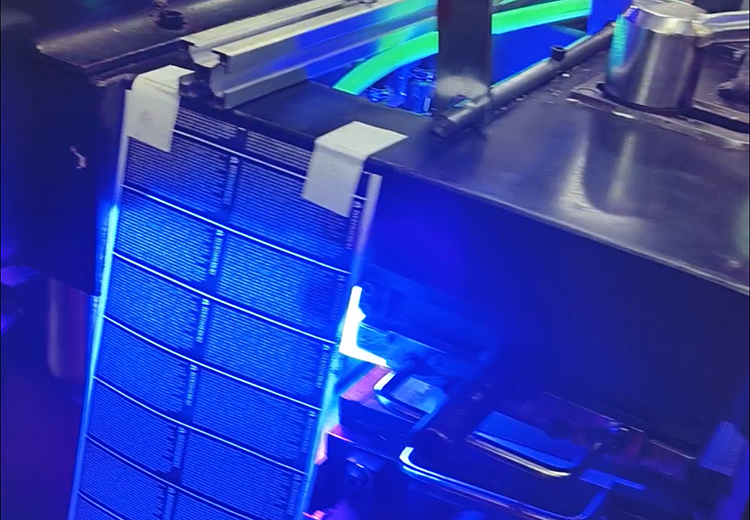
. Implementation and Project Results
After the preliminary free proofing tests verified the curing performance of different inks and the film deformation situation, the solution was confirmed and the customized lamp head was produced. After delivery, our technicians installed and wired the equipment on site, and commissioned it; we also trained the customer’s operators on equipment operation as well as filter and water-circuit maintenance. The complete unit comes with a two-year warranty, and after-sales engineers respond quickly to production line issues.
The following results were achieved after entering mass production:
1. Cold-light low-temperature curing means PET/PP film no longer stretches and wrinkles under heat; registration defects dropped sharply, with registration deviation controlled within ±0.05~0.08mm;
2. Dark solid ink is fully cured, label gloss is uniform, and no color fading occurs in the 3M tape peel test;
3. The light comes on instantly with no warm-up required, supporting high-speed uninterrupted printing with a stable production cycle; line speed increased from 60 m/min to 90 m/min;
4. The film label reject rate dropped from 4.2%~6.5% to 0.5%~0.8%; based on a monthly output of 8 million labels, about 300,000 fewer rejects are produced each month;
5. Compared with the traditional mercury lamp, it saves about 75% of electricity; the light source lasts 20000~30000 hours, eliminating the losses caused by frequent tube purchasing and downtime replacement;
6. No ozone is generated, the workshop odor is eliminated, the exhaust equipment load is reduced, and the operators’ working environment has improved noticeably.
If your production line also suffers from slow curing, unstable adhesion, or heat damage, please feel free to contact us. We accept sample curing tests and provide test reports with measured data. Custom mounting fixtures and energy adjustment services are available.