Silk-screen Marking on Cosmetic Shells | 395nm YJT-CT4-100GA LED UV Curing Improves Printing Efficiency
News 2026-11-06
| Project | Details |
|---|---|
| Person in Charge | Mr. Chen |
| Factory Address | Guangzhou, Guangdong, China |
| Enterprise Type | OEM Processing Factory (Cosmetic Packaging Printing) |
| Number of Employees | Approximately 120 |
| Main Products | Silk-screen printing and printing for cosmetic bottle bodies and housings |
| Downstream End Customers | Domestic and overseas beauty brand clients |
| Key Processes Involved: | Automatic Silk-screen Printing → UV Ink Curing → Inspection → Packaging |
| Ink Used | UV silk-screen ink specially formulated for cosmetic housings, peak light absorption at 395 nm UVA band |
| Ink Layer Thickness | 15~25 μm per single print |
| Printing Substrate Combinations | Glass bottles, plastic (PET/PP/ABS) bottles, metal housings |
| Curing Equipment Before Retrofit | Traditional medium-pressure mercury lamp UV curing machine |
| Production Line Configuration | Semi-automatic silk-screen printing + continuous online conveyor line |
| Line Speed Before Retrofit: | 3 m/min |
| Target Line Speed Required by Client: | ≥8 m/min |
| Workshop Condition: | Constant temperature 23±2℃, general clean workshop |
| Core Pain Points Before Retrofit | ①.Long preheating time for mercury lamps; cannot be turned on and used immediately ②.Long curing cycle restricts printing production capacity ③.Incomplete ink curing, unstable adhesion and wear resistance ④.High thermal radiation, causing easy deformation of plastic bottles ⑤.High defect rate, heavy delivery pressure for rush orders |
| elected Equipment Model | YJT-CT4-100GA LED UV Curing System Operating |
| Wavelength: | 395 nm |
| Installation Method | In-line, installed after the silk-screen printing station |
| Client Acceptance Criteria | ①Instant startup with no preheating required ②Surface dry and full curing achieved within seconds ③Stable ink adhesion and wear resistance ④Low temperature rise on substrates ⑤Marked reduction in mass production defect rate |
| Reliability Test Standards | ASTM D3359 Cross-Cut Tape Adhesion Test; 85℃/85% RH 240h double 85 damp heat aging test |
| Project Timeline | Sample Trial & Confirmation: 3 working days Equipment Delivery + On-site Installation & Commissioning: 7 working days |
| Expected Benefits for Client | Support rush order delivery, reduce rework costs, and eliminate recurring replacement expenses for mercury lamp consumables. |
This cosmetic packaging OEM factory is located in Guangzhou, with Mr. Chen as the contact person. It has around 120 employees and specializes in silk-screen printing services on cosmetic bottle bodies and housings for domestic and overseas beauty brands. The production line adopts UV silk-screen ink for surface printing on glass bottles, plastic bottles and metal housings. The photoinitiator of the ink is formulated for the 395 nm UVA band.
Before the retrofit, the factory used traditional medium-pressure mercury lamp UV curing machines. As an OEM manufacturer handling numerous batches and tight delivery schedules, long curing time became the major bottleneck limiting printing capacity. Mercury lamps require preheating, and their broad spectrum poorly matches the ink absorption peak. Even with extended irradiation time, the ink coating suffered from incomplete curing and unstable adhesion and abrasion resistance. Some products showed discoloration or ink peeling after reliability aging tests. Slow curing speed capped the conveyor speed and daily output, making it difficult to meet tight lead-time requirements from brand customers.
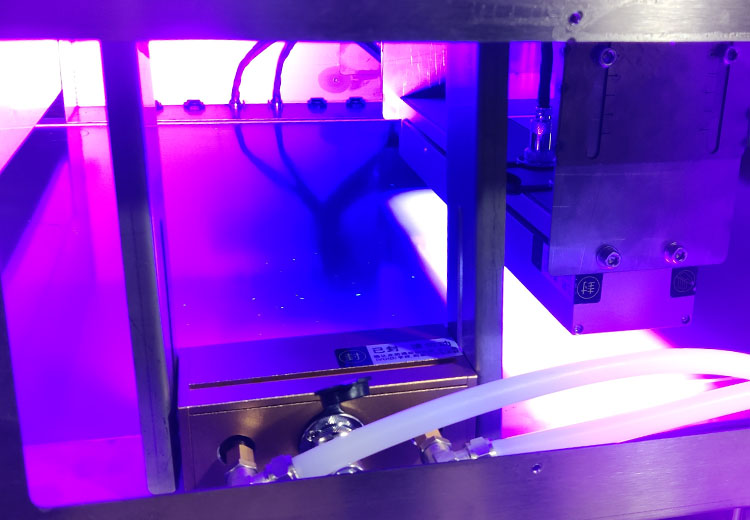
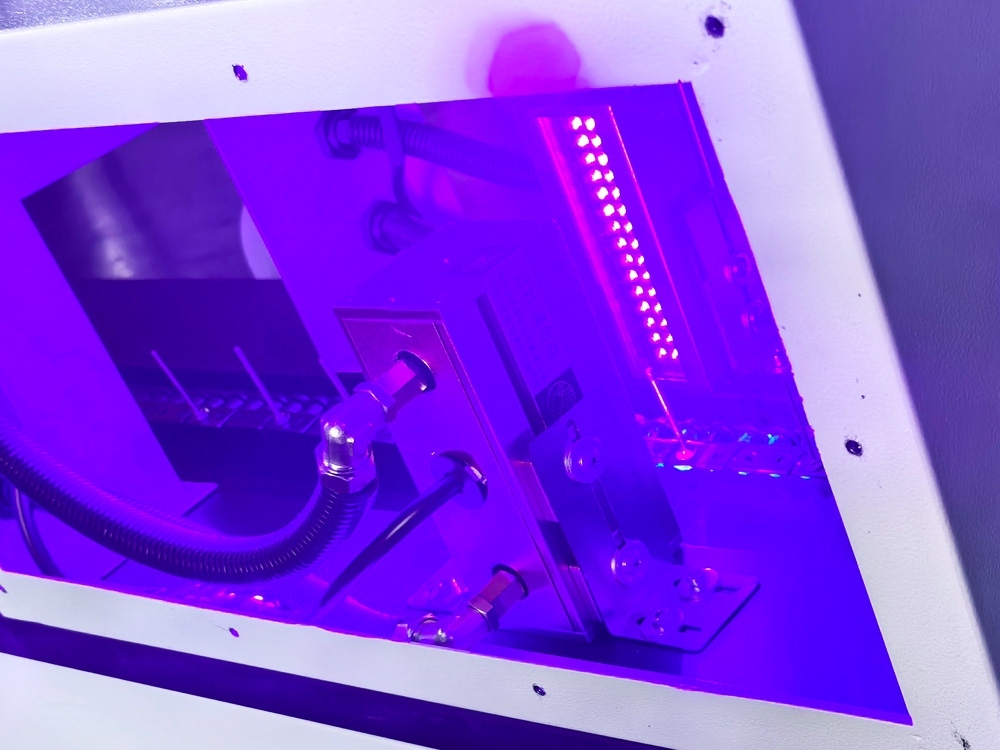
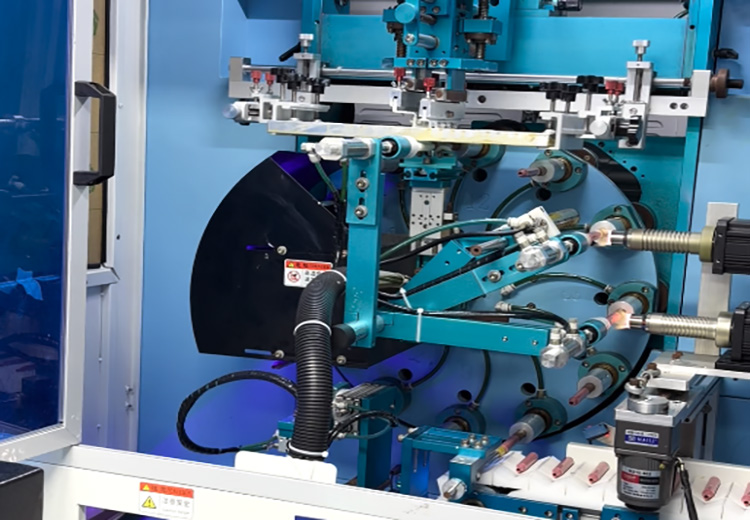
We conducted side-by-side comparative curing tests under identical substrates, similar ink thickness (20 μm) and consistent workshop conditions. The recommended solution is the 395 nm narrow-spectrum YJT-GCT4 LED UV curing lamp, which precisely matches the absorption curve of the factory’s silk-screen ink. The unit is installed in-line on the conveyor right after the silk-screen printing station.
Comparative test results are shown in the table below:
| Test Item | Unit | Traditional Mercury Lamp Solution | YJT-CT4-100GA | Test Basis |
|---|---|---|---|---|
| Rated Power | W | 400 | 700 | Product Specification |
| Peak Irradiance of Equipment | mW/cm² | 450~550 | 1400~1600 | Tested by UV Radiometer |
| Working Distance | mm | 80~120 | 60~90 | Production Setting |
| Curing Time (20 μm Ink Layer) | s | 12~16 | 2~4 | Visual Inspection + Tack-Free Test |
| Preheating Waiting Time | s | 180~240 | 0 (Instant On) | On-site Production Record |
| Total Energy Required for Full Curing | mJ/cm² | 850~950 | 400~460 | Tested by UV Radiometer |
| Average Cross-Cut Adhesion Grade | Grade | 3~4 | 5 | ASTM D3359 Cross-Cut Tape Adhesion Test |
| Batch Printing Defect Rate | % | 3.5~4.8 | 0.4~0.6 | Continuous Sampling of 2000 pcs |
| Adhesion Retention Rate after 85℃/85% RH, 240h | % | 70~76 | 92~95 | Damp Heat Aging Test |
| Surface Temperature of Plastic Substrate | ℃ | 62~70 | 32~38 | Infrared Thermometer |
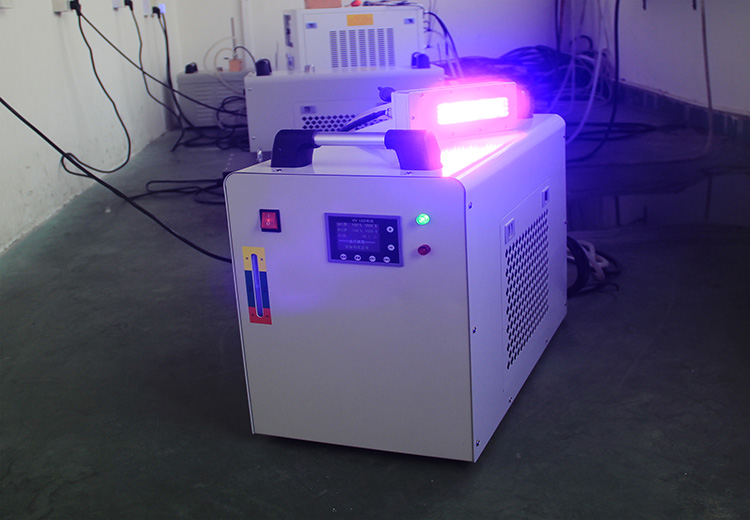
After optimizing power density and conveyor speed, the high-energy 395 nm UV light precisely matches the ink absorption peak. It achieves surface dry and deep curing of the ink within seconds, eliminating the problem of surface curing while the inner layer remains uncured. The cured printed layer features rich, consistent color with stable adhesion and abrasion resistance. Low thermal load prevents deformation of plastic bottles and overheating of glass bottles, ensuring high yield.
Following mass production launch, the customer’s line speed increased from 3 m/min to 9 m/min. For this OEM factory, this upgrade greatly boosts delivery efficiency for Mr. Chen’s team and enables them to meet short lead-time requirements from brand customers.
This 395 nm LED UV curing solution is suitable for various applications including silk-screen printing on cosmetic bottles, housing printing, and UV ink curing on glass, plastic and metal surfaces.
If your production line is troubled by slow curing, unstable adhesion or thermal damage issues, please feel free to contact us. We support sample curing tests and can provide test reports with measured data. Custom fixtures and energy adjustment services are available.