Plastic Parts UV Spray Coating | LED UV Curing Lamp Solves Thermal Deformation and Paint Cracking of Plastic Parts
News 2026-11-18
Project Information
| Item | Details |
| Contact Person | Mr. Chen |
| Factory Address | Dongguan, Guangdong, China |
| Company Type | UV spray coating processing factory |
| Number of Employees | About 150 people |
| Main Products | UV topcoat spray coating on plastic shells for daily-use products and small home appliances |
| Downstream End Customers | Small home appliance brands, daily-use product brands, and 3C digital accessory customers |
| Core Process Involved | Automatic spraying → UV topcoat leveling → UV curing → Cooling and unloading → Finished-product inspection |
| Coating Used | UV topcoat, with light absorption peak in the 395nm UVA band |
| Spraying Substrates | ABS, PC, PP plastic parts |
| Curing Equipment Before Retrofit | Conventional high-pressure mercury lamp UV curing machine (tunnel type) |
| Production Line Configuration | Automatic spray coating line + tunnel curing furnace |
| Line Speed Before Retrofit | 3 m/min |
| Target Line Speed | ≥5 m/min |
| Workshop Conditions | Constant temperature 23±2℃; cleanroom class 10,000 in the spray booth |
| Core Pain Points Before Retrofit | 1. Heavy infrared heat radiation from the mercury lamp causes thin-wall plastic parts to warp and deform under heat 2. Light-colored products turn yellow; dark solid topcoat is not fully cured 3. Poor paint film adhesion; chipping and cracking on impact 4. Long mercury lamp warm-up, fast tube decay, high consumable cost 5. Strong ozone odor; exhaust equipment runs at high load |
| Selected Equipment Model | YJT-CT4-400A water-cooled LED UV curing system |
| Working Wavelength | 395 nm |
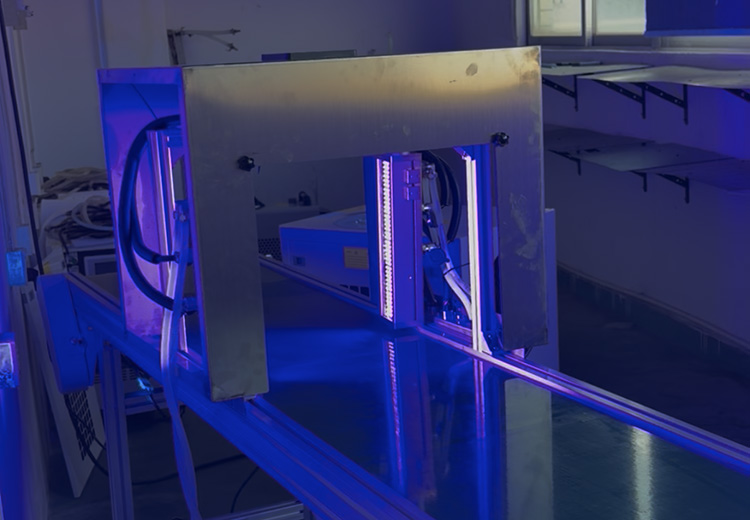
| Installation Method | Inline type; installed in the tunnel furnace after the spray leveling station |
| Customer Acceptance Criteria | 1. No warping, deformation, or yellowing of plastic parts 2. Dark topcoat fully cured; cross-hatch adhesion meets the standard 3. Low surface temperature rise on workpieces 4. Instant on, no warm-up required 5. No ozone generated; improved workshop environment |
| Reliability Test Standards | ASTM D3359 cross-hatch adhesion test; paint film pencil hardness test; thermal cycling test |
| Project Timeline | Sample proofing confirmation: 3 working days Equipment delivery + on-site installation and commissioning: 7 working days |
| Expected Benefits for the Customer | Lower spray coating defect rate, reduced rework cost, savings on tube consumables and electricity, and an improved workshop working environment |
1. Project Background
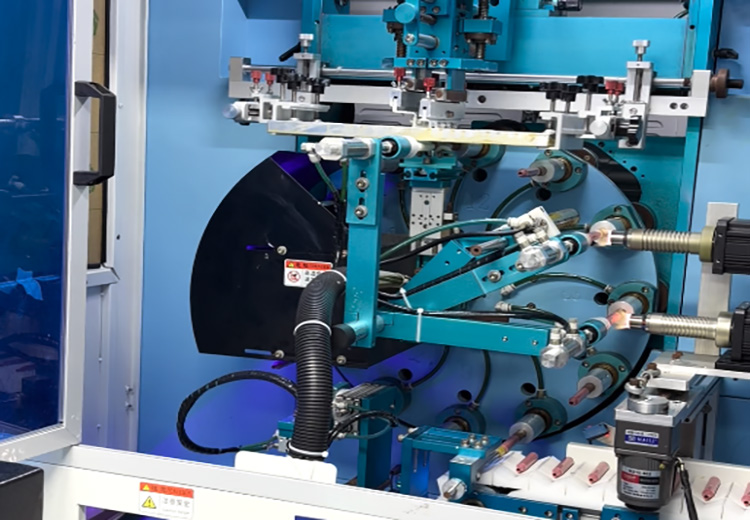
The customer is located in Dongguan, Guangdong, with Mr. Chen as the contact person. The factory has about 150 employees and specializes in providing UV spray coating services for plastic shells of small home appliances, daily-use products, and 3C digital brands. As a global manufacturing hub, Dongguan is surrounded by a large number of home appliance and consumer electronics OEM factories, giving rise to strong demand for plastic spray coating. The customer operates several automatic spray coating lines, applying UV topcoat to plastic parts such as ABS, PC, and PP; products include fan housings, humidifier panels, remote control shells, storage boxes, and other daily-use items.
Before the retrofit, the curing equipment in the tunnel furnace was a conventional high-pressure mercury lamp. As the share of thin-wall plastic parts and dark-colored products in customer orders increased, the thermal damage from the mercury lamp became increasingly severe: the heavy infrared heat radiation warped and deformed thin-wall plastic parts below 0.8mm after they passed through the curing furnace, failing flatness requirements; light-colored (white, beige) products turned yellow on the surface after high-temperature baking, keeping the appearance defect rate high; dark solid topcoats (black, dark blue, dark red) tended to dry on the surface but remain uncured inside, with insufficient paint film adhesion that led to chipping and cracking during assembly; the mercury lamp required 5~10 minutes of warm-up, could not be started and stopped frequently, and the tube needed replacement after about 800~1000 hours of decay, with frequent downtime causing capacity losses; the strong ozone odor kept the workshop exhaust system running at high load year-round, and operators reported noticeable pungent smells. The customer urgently wanted to upgrade the curing solution to control workpiece temperature rise and stabilize spray coating yield.
2. Solution Selection
Our engineers visited the customer’s spray coating line in Dongguan for an on-site survey. Taking into account the heat resistance of the plastic substrates, the absorption curve of the UV topcoat formulation, and the line speed, we recommended a water-cooled LED UV curing lamp. The 395nm wavelength was chosen to precisely match the photoinitiator absorption peak of the plant’s UV topcoat; the face-emitting surface was non-standard customized to the width of the sprayed workpieces inside the tunnel furnace to ensure even intensity coverage across the entire width. UV energy is continuously adjustable from 0~100%, with a 30% power margin reserved for curing dark, thick-applied topcoats. The unit interfaces with the line PLC signal so the light source starts and stops in sync with the conveyor. The water-cooling system keeps light intensity stable without decay during long continuous production, while the cold light source fundamentally lowers the temperature rise of plastic workpieces and avoids high-temperature deformation and yellowing.
3. Proofing Tests and Comparative Data
Before the formal retrofit, we conducted side-by-side comparison proofing tests at the customer’s site using the same thin-wall ABS specimens, the same UV topcoat color group, and the same workshop conditions. The test results are shown in the table below:
| Test Item | Unit | Mercury Lamp | YJT-CT4-400A LED UV Curing Lamp | Test Basis |
| Rated Power | W | 400 | 2890W | Product Specification |
| Peak Energy | mW/cm² | 380~450 | 11000~25000 | Measured with UV radiometer |
| Working Distance | mm | 150~200 | 50~80 | Production Setting |
| Curing Time | s | 15~25 | 3~5 | Appearance + non-tacky check |
| Warm-up Waiting Time | s | 300~600 | 0 (instant on) | On-site production line record |
| Energy Required for Full Curing | mJ/cm² | 700~800 | 300~350 | Measured with UV radiometer |
| Paint Film Adhesion | Grade | 2~3 | 4~5 | ASTM D3359 cross-hatch test |
| Paint Film Pencil Hardness | H | B~HB | H~2H | Pencil hardness tester |
| Overall Spray Coating Defect Rate | % | 5.5~8.0 | 0.6~1.0 | Statistics over 5,000 consecutive parts |
| Dark Topcoat Curing Result | — | Surface dry, inner layer not dry | Fully cured | 3M tape peel test |
| Yellowness Index Δb of White Parts | — | 2.8~3.5 | 0.5~0.8 | Colorimeter measurement |
| Workpiece Surface Temperature | ℃ | 70~85 | 35~42 | Infrared thermometer |
4. Implementation and Project Results
After the preliminary free proofing verified the curing performance of topcoats in different colors and the temperature rise of plastic parts, the solution was confirmed and the customized lamp head was produced. After delivery, our technicians installed and wired the equipment on site, and commissioned it; we also trained operators on equipment operation as well as daily maintenance of the water circuit and lamp surface. The complete unit comes with a two-year warranty, and after-sales engineers respond quickly to production line issues.
The following results were achieved after entering mass production:
1. Cold-light low-temperature curing leaves ABS/PC thin-wall plastic parts free of warping and deformation; the yellowness index Δb of white parts dropped from 2.8~3.5 to 0.5~0.8, and appearance yield improved significantly;
2. Dark solid topcoat is fully cured; cross-hatch adhesion reaches grade 4~5, and pencil hardness improved from B~HB to H~2H; chipping and cracking defects dropped sharply;
3. The light comes on instantly with no warm-up required, suiting continuous automatic spray coating production; line speed increased from 3 m/min to 6 m/min;
4. The overall spray coating defect rate dropped from 5.5%~8.0% to 0.6%~1.0%; based on a monthly output of 200,000 parts, about 12,000 fewer rework pieces are produced each month;
5. Compared with the traditional mercury lamp, it saves about 75% of electricity; the light source lasts 20000~30000 hours, eliminating the capacity losses from frequent tube purchasing and downtime replacement;
6. No ozone is generated, the pungent workshop odor is eliminated, the exhaust system load is reduced, and the operators’ working environment has improved noticeably.
If your production line also suffers from slow curing, unstable adhesion, or heat damage, please feel free to contact us. We accept sample curing tests and provide test reports with measured data. Custom mounting fixtures and energy adjustment services are available.