PCB Three-Proof Coating UV Curing Case | YJT-CT4-400C LED UV Curing Improves Coating Efficiency
News 2026-11-10
| project | Detailed Information |
| Point of Contact | Mr. Li |
| Factory Address | Shenzhen, Guangdong, China |
| Enterprise Type | EMS (Electronics Manufacturing Services) Factory |
| Number of Employees | About 180 people |
| Core Products | PCBA circuit board |
| Downstream end customers | Clients in automotive electronics, industrial control, and home appliance control boards |
| Involves core processes | Automatic coating → UV conformal coating curing → Unloading → Inspection |
| Use glue | UV-curable conformal coating for PCBs, with an absorption peak at 365 nm (UVA band). |
| Coating thickness | 25–50 μm per application |
| Coated Substrate Combination | FR-4 fiberglass board, aluminum-based substrate, and the surfaces of electronic components |
| Curing equipment before modification | Traditional Medium-Pressure Mercury Lamp UV Curing System |
| Production line configuration | Automated Coating + Continuous In-line Conveyor System |
| Production line speed before modification | 2 m/min |
| Target production line speed for the client | ≥5 m/min |
| Workshop Operating Conditions | Constant temperature of 24±2°C, standard electronics workshop |
| Key pain points before the transformation | Mercury lamps require a long warm-up period and cannot be used immediately upon startup. Curing takes a long time, limiting production capacity for conformal coating. Incomplete curing of the conformal coating leads to inconsistent adhesion and moisture resistance. High thermal radiation poses a risk of overheating for sensitive electronic components. High defect rates create significant pressure when fulfilling urgent orders. |
| Operating wavelength range | 365 nm |
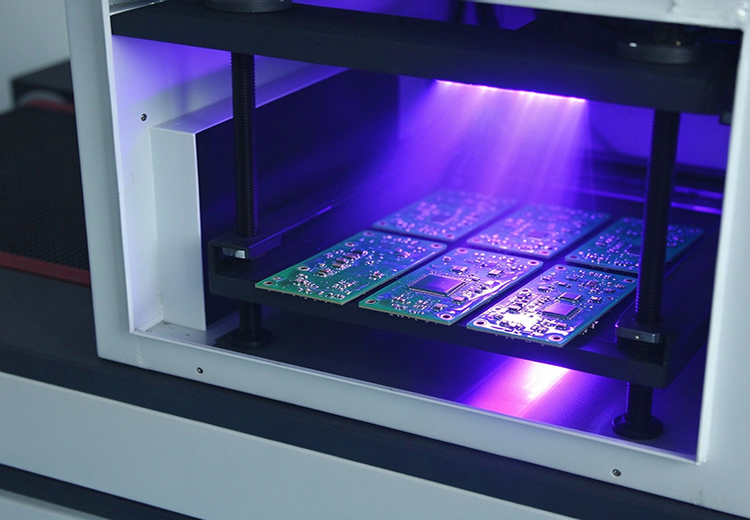
| Installation Method | In-line type; installed after the automatic coating station. |
| Customer Acceptance Criteria | Instant-on; no preheating required Achieves both surface-dry and full-cure states within seconds Stable coating adhesion and moisture resistance Minimal temperature rise on the substrate surface Significant reduction in batch defect rates |
| Reliability Testing Standards | IPC-CC-830C 65°C/90% RH, 240 h, damp heat |
| Project Duration | Sample proofing and confirmation: 3 business days Equipment delivery + on-site installation and commissioning: 7 business days |
| Expected Client Returns | Meet urgent delivery deadlines, reduce rework costs, and eliminate the ongoing expense of replacing mercury lamp consumables. |
This EMS (Electronics Manufacturing Services) facility, located in Shenzhen and managed by Mr. Li, employs approximately 180 people. The factory specializes in providing conformal coating and curing services for PCBA (Printed Circuit Board Assembly) products, serving downstream clients in sectors such as automotive electronics and industrial control. The production line utilizes UV-curable conformal coatings—designed with photoinitiators responsive to the 365nm UVA spectrum—to protect the surfaces of FR-4 fiberglass boards, aluminum-based substrates, and electronic components.
Prior to the upgrade, the facility relied on conventional medium-pressure mercury-arc UV curing lamps. As a contract manufacturer handling high-mix, short-lead-time orders, the long curing cycle became the primary bottleneck for production capacity. Mercury lamps require a warm-up period, and their broad-spectrum output aligns poorly with the absorption peaks of the conformal coatings used. Even with extended exposure times, the coatings often failed to cure completely, leading to inconsistent adhesion and moisture resistance; some products even exhibited blistering or delamination during reliability aging tests. The slow curing process limited conveyor belt speeds and overall daily output, making it difficult to meet the tight delivery schedules required by downstream customers.
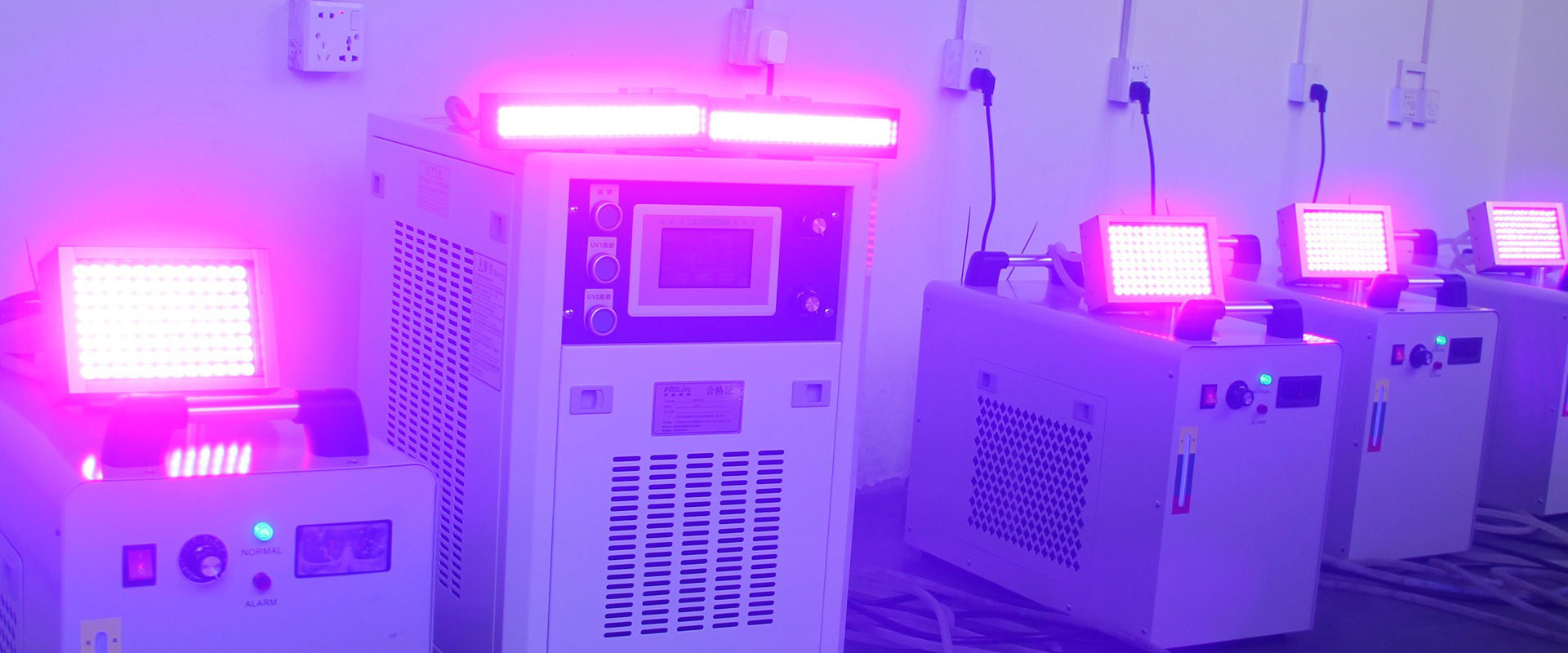
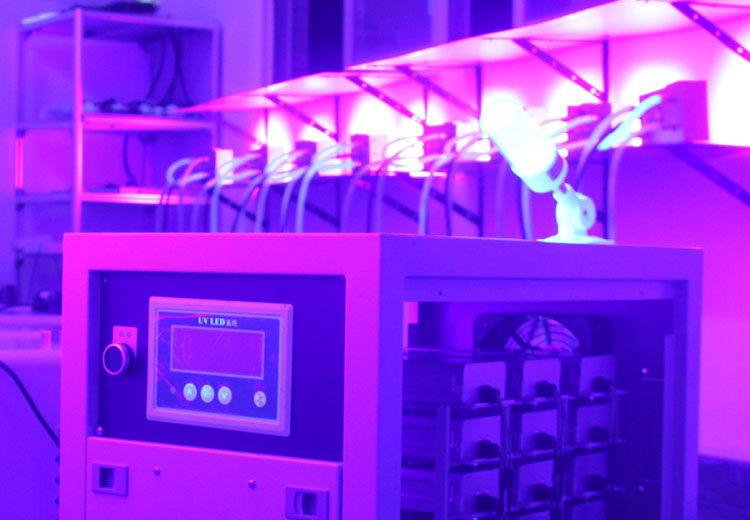
We conducted side-by-side comparative curing tests using the same substrates, similar coating thicknesses (50μm), and the actual operating conditions of the workshop. We recommended the YJT-CT4-400C LED UV curing system, which features a 365nm narrow-spectrum output precisely matched to the absorption curve of the factory’s conformal coating. The equipment was installed inline on the conveyor system, positioned immediately after the automated coating station.
The results of the comparative tests are presented in the table below:
| Test Items | unit | Traditional mercury lamp solution | YJT-CT4-400C | Basis for Testing |
| Rated power | W | 400 | 1200 | Product Specification |
| Working distance | mm | 80~120 | 60~90 | Production Settings |
| Curing time (50μm coating) | s | 15~20 | 2~4 | Appearance + Non-tackiness Test |
| Warm-up waiting time | s | 180~240 | 0 (ready to use immediately) | Production Line On-Site Records |
| Energy required for complete curing | mJ/cm² | 850~950 | 400~460 | UV Irradiance Measurement |
| Adhesion | grade | 3-4 | 4-5 | ASTM D3359 |
| Defect rate for batch coating | % | 3.5~4.8 | 0.4~0.6 | 2,000-piece continuous sampling |
| 65℃/90%RH 240H | % | 70~76 | 92~95 | Damp-heat aging test |
| Surface temperature of the board | ℃ | 58~66 | 33~38 | 红外测温仪 |
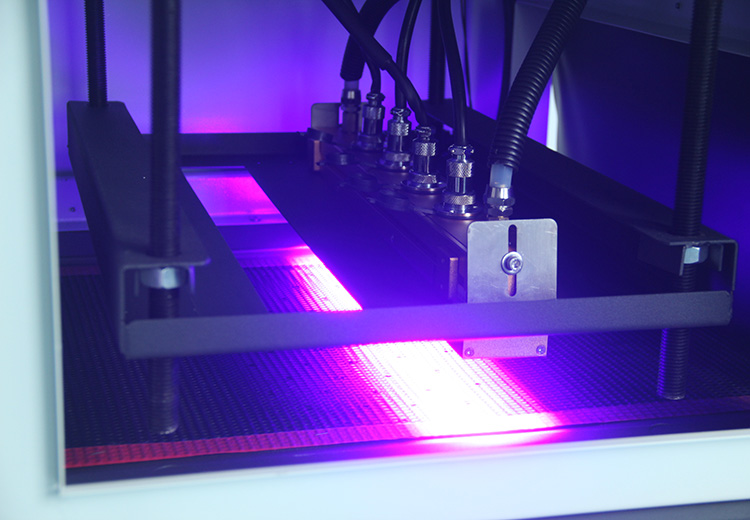
By optimizing power density and conveyor belt speed, our 365nm high-energy UV light source—precisely matched to the absorption peak of conformal coatings—achieves both surface and deep-layer curing within seconds, ensuring a uniform cure throughout. The resulting coating is dense, exhibits excellent adhesion and moisture resistance, and minimizes thermal load, preventing sensitive electronic components from overheating and thereby safeguarding high production yields.
Following full-scale implementation, the client’s production line speed increased from 2 m/min to 6 m/min. For this contract manufacturer, the improvement has significantly boosted delivery efficiency, enabling them to meet the tight turnaround requirements of their downstream customers.
This 365nm LED UV curing solution is suitable for a wide range of applications, including the curing of conformal coatings on PCBs, selective coating for PCBAs, and the curing of protective coatings on electronic components.
If your production line faces challenges such as slow curing, inconsistent adhesion, or thermal damage, please contact us. We offer sample curing tests, complete with detailed test reports containing empirical data. Custom mounting fixtures and energy-output adjustment services are also available.