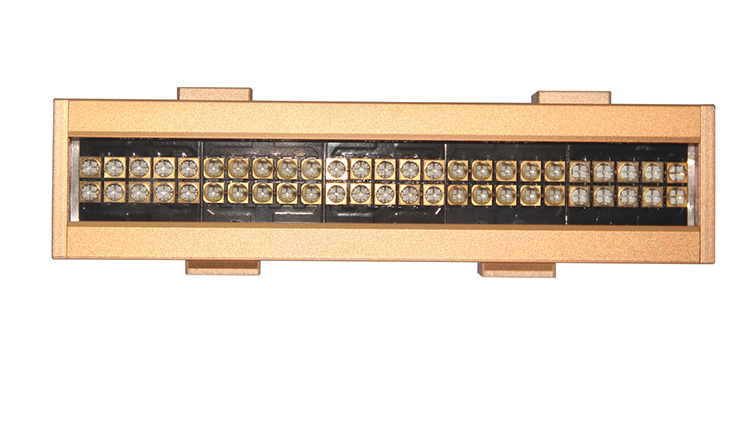
Long-Term Energy Stability: Stop Yield Decline and Eliminate Frequent Replacements
News 2026-10-31
When you install a new UV curing system, expectations are high. The line runs fast, the adhesives cure perfectly, and the quality control team is happy. But fast forward 12 to 18 months. Slowly, almost imperceptibly, the quality begins to slip. You start seeing tacky surfaces or failed adhesion tests. What happened? The system is experiencing energy degradation. In high-stakes manufacturing, a curing system that “gets worse over time” is a massive liability. Long-term energy stability is the only way to guarantee that your yield today will be exactly the same as your yield years from now.
The Silent Killer of Manufacturing: Energy Decay
Traditional UV curing systems, particularly those using mercury lamps or lower-tier LED arrays, are prone to energy decay.
The Halogen/Mercury Effect: As the lamp ages, the electrodes degrade, and the gas inside loses its efficiency. The UV output drops significantly within hundreds of hours.
Thermal Degradation in LEDs: Even in LED systems, if the thermal management is inadequate, the junction temperature of the chip rises. Over time, this heat permanently damages the semiconductor, drastically reducing light output.
The Domino Effect on Production: As UV energy drops, operators are forced to slow down the conveyor belt or turn up the power to compensate. If they don’t, the product is undercured. Eventually, the system can no longer deliver the required dose, and parts must be scrapped.
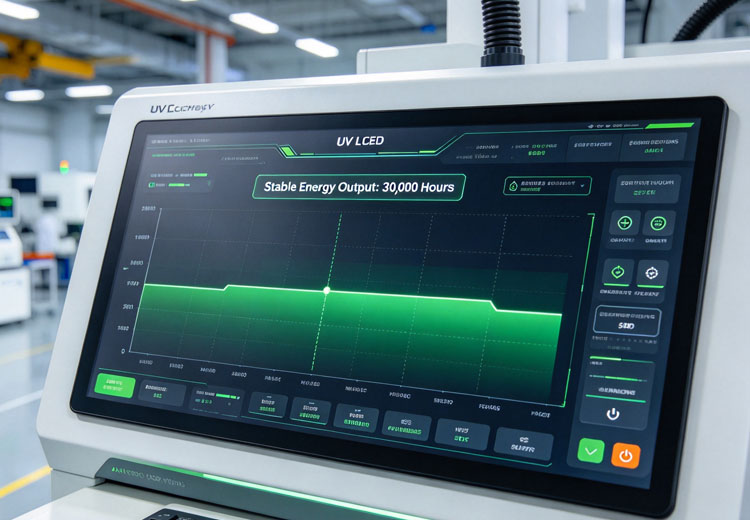
What True Long-Term Energy Stability Looks Like
Long-term energy stability means that the UV output at hour 20,000 is virtually identical to the output at hour 1. It is not just about extending the lifespan of a part; it is about protecting the integrity of your manufacturing process.
Consistent Yield: If the energy is stable, the chemical reaction in the adhesive is stable. You eliminate the guesswork and the slow, frustrating decline in product quality.
No “Chasing the Process”: Engineers no longer need to constantly adjust line speeds or recalibrate parameters to make up for a weakening light source.
Predictable Maintenance: Instead of sudden failures and emergency replacements, maintenance becomes a planned, routine event.
The Engineering Behind “No Decline”
Achieving long-term energy stability requires a system-level engineering approach:
Advanced Thermal Architecture: This is the most critical factor. By utilizing high-efficiency water cooling and massive heat sinks, the LED junction temperature is kept strictly controlled. If the chip runs cool, it does not suffer from thermal decay.
Closed-Loop Optical Feedback: High-end UV systems use internal sensors to monitor the actual UV output continuously. If the system detects even a microscopic drop in intensity, the driver instantly increases the electrical current to maintain a perfectly flat energy curve.
Premium Semiconductor Materials: High-quality epitaxial wafers and robust packaging prevent the microscopic lattice defects that cause LEDs to lose brightness over time.
Eliminating the Cycle of Frequent Replacements
When energy stability is guaranteed, the era of frequent replacements ends.
Cost Savings: You no longer need to budget for expensive replacement bulbs or LED modules every few months. The initial investment is protected for tens of thousands of hours.
Zero Downtime: The production line does not need to be stopped for constant part swapping. This drastically improves Overall Equipment Effectiveness (OEE).
Less Scrap: Because the energy is consistent from day one to year five, you do not have to throw away the first few batches after a replacement while trying to recalibrate the machine.
Don’t let a degrading light source silently destroy your hard-earned yield. The true value of a UV curing system is not how it performs on the first day, but how it performs on the thousandth day. By investing in systems engineered for long-term energy stability, you eliminate the invisible decline in quality, stop the cycle of frequent replacements, and ensure that your manufacturing process remains flawless for years to come.
Frequently Asked Questions (FAQ)
Q: Why does my UV curing quality seem to drop over time?
A: This is usually caused by energy decay. As the light source (lamp or LED) ages, its UV output drops. If the system does not compensate for this, the adhesive receives less energy, leading to undercuring and a decline in yield.
Q: How do modern systems maintain long-term energy stability?
A: They use closed-loop control and advanced thermal management. Sensors monitor the light output, and the system automatically adjusts power to keep the UV energy perfectly constant, regardless of the light source’s age.
Q: Will I still need to replace parts frequently?
A: No. By preventing thermal degradation and maintaining stable energy, the lifespan of the UV modules is drastically extended. You eliminate the frequent, costly replacements associated with traditional systems.