LED UV Curing Process for Glass Bonding with UV Adhesive: Principles, Advantages & Practical Troubleshooting Guide
News 2026-07-24
Glass product bonding is in huge demand across many industries, including handicrafts, glass furniture, sanitary glass, optical lenses, automotive glass, display cabinets and photovoltaic glass modules. Conventional glass bonding mostly relies on two-part AB adhesive and slow-curing epoxy resin. These traditional adhesives require several hours to fully cure, and frequently suffer from drawbacks such as yellowing, bubbles inside the bonding layer, poor water resistance and insufficient bonding strength. Nowadays, a growing number of processing factories have switched to the cold-light curing solution combining special UV glass adhesive and LED UV curing lamps. High-strength bonding can be finished within several seconds, making this the mainstream option for glass deep processing factories to boost productivity and improve finished product yield.
I. Why LED UV Curing Is Perfectly Suited for Glass Bonding
1.High light transmittance of glass enables thorough UV penetration for complete curing
Ordinary adhesives cure slowly through spontaneous chemical reactions, while UV adhesives depend on ultraviolet rays of specific wavelengths to trigger molecular crosslinking polymerization. Glass features high transmittance to visible light and UVA ultraviolet rays. LED ultraviolet light at 365nm and 395nm wavelengths can easily penetrate the glass surface and reach deep inside the adhesive layer, achieving full crosslinking curing from inside out. This effectively avoids incomplete curing problems where only the surface dries but the inner part remains soft — a natural advantage that acrylic and plastic substrates cannot match.
2.LED UV curing lamps are cold light sources with low heat output, preventing glass damage
Despite high hardness, uneven-thickness glass, curved tempered glass and ultra-thin float glass are prone to stress cracking and minor deformation under high temperatures. Traditional mercury lamp UV curing equipment generates massive heat; close-range irradiation causes uneven local heating on glass, resulting in internal residual stress that may lead to spontaneous cracking during later use. In contrast, LED UV curing lamps are pure cold light sources with extremely low temperature rise on workpieces during irradiation. Water-cooled LED UV equipment delivers even more stable temperature control. It can safely cure ultra-thin glass, coated glass and decorative glass with printed patterns without scratching or damaging surface coatings and printed layers.
3.Ultra-fast curing drastically boosts assembly line throughput
AB adhesives need at least 2 to 6 hours for room-temperature curing, or more than 30 minutes with oven heating. Factories have to reserve large storage areas for semi-finished products waiting to dry, occupying valuable workshop space and turnover capacity. When using LED UV curing lamps, UV glass adhesive achieves full curing and rated bonding strength within merely 1–10 seconds after dispensing. Products can be immediately stacked, polished, packaged or transferred to the next working procedure, directly doubling the daily output of a single production line. The economic benefits are particularly tangible for glass manufacturers with large order volumes.
II. Common Defects in Glass UV Adhesive Curing with LED UV Lamps & Corresponding Solutions
Many factories encounter bonding failure, hazy adhesive seams, tacky glue surface and watermark traces right after launching this new process. Such issues rarely stem from defective lamps but almost always result from mismatched process parameters and material matching.
1.Delamination and poor adhesion after long-term use
Two root causes account for this problem:
First, bonding surfaces are contaminated with release agent, oil stains, dust or fingerprints, which stop UV adhesive from fully wetting the glass substrate.
Second, mismatched wavelength between the LED UV curing lamp and UV adhesive. Most glass-specific UV adhesives are formulated to respond to 365nm UV light; 395nm light fails to provide enough penetration for deep-layer curing.
Solutions: Thoroughly wipe bonding surfaces with alcohol and let them air dry before dispensing glue; uniformly adopt 365nm water-cooled LED UV curing lamps to guarantee sufficient crosslinking deep inside the adhesive layer.
2.Whitish, foggy glue seams ruining the transparent appearance of glass
This fault frequently occurs in thick gap filling and large-area glass splicing. Single-wavelength UV light from LED lamps tends to cure the outer surface rapidly and form a sealed hard shell, trapping tiny internal moisture which eventually forms white haze. Excessively thick single dispensing also blocks UV penetration and leads to cloudiness.
Practical fixes: Reduce glue thickness per dispensing; fill wide gaps with two rounds of dispensing and two rounds of UV irradiation. Maintain low humidity in the production workshop and select high-clarity UV invisible adhesive specially designed for glass.
3.Sticky and uncured adhesive surface
This is a typical oxygen inhibition issue. LED UV curing lamps do not emit short-wave UV rays, so oxygen in the air interrupts the free-radical polymerization reaction on the adhesive surface. Narrow gaps between spliced glass trap air and worsen this inhibition effect.
Countermeasures: Appropriately raise the power density of LED UV lamps and slightly extend irradiation duration; purchase high-grade glass UV adhesive added with anti-oxygen-inhibition additives. Install small nitrogen purging devices on production lines or apply high-intensity close-range UV exposure to supplement surface curing.
4.Uneven irradiation on curved special-shaped glass leading to incomplete curing on edges and corners
Single-point light sources leave blind spots when curing long glass handrails, curved sanitary glass and circular glass ornaments. Select matched equipment according to workpiece shapes:
Small spot bonding: Adopt LED UV point light source curing lamps for precise light spots, low power consumption, suitable for desktop manual stations or semi-automatic dispenser integration.
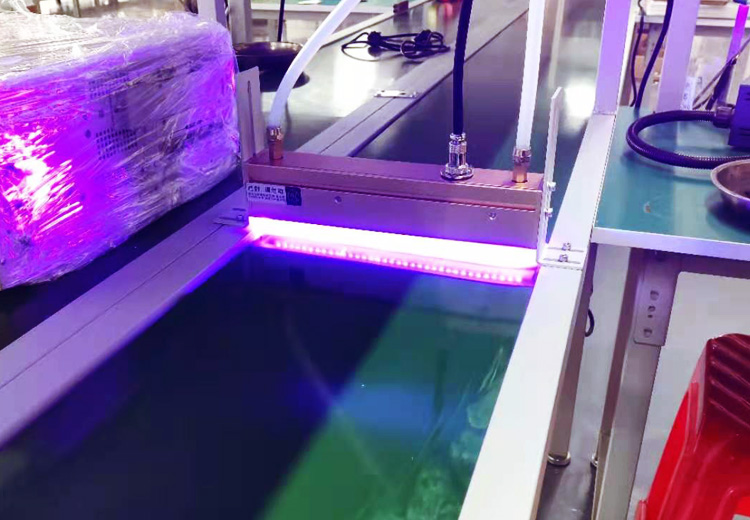
Long linear seam bonding: Deploy water-cooled linear LED UV curing lamps with uniform light output, mounted above conveyor belts for continuous mass automated production.
Large-area full-surface lamination: Use high-power water-cooled surface light source LED UV curing equipment, which delivers outstanding illumination uniformity and minimal light decay during 24-hour non-stop mass production.
III. Long-Term Hidden Benefits of Using LED UV Curing for Glass Adhesives
From the perspective of long-term operating costs, LED UV curing lamps feature a service life of 20,000 to 50,000 hours and consume only one-quarter of the electricity of traditional mercury lamps. They require almost no frequent replacement of consumable parts, produce no mercury pollution or ozone emissions, fully comply with European and American environmental regulations, and easily pass RoHS compliance tests — a huge advantage for glass product exporters.
Fully cured UV glass adhesive boasts high transparency, excellent anti-yellowing performance, boiling water resistance and UV aging resistance. Bonded products will not turn yellow or delaminate even under long-term outdoor exposure, greatly improving end-user reputation and product competitiveness.
Conclusion
Amid the general trend of glass bonding process upgrading, the combination of UV invisible adhesive and LED UV curing lamps has become the standard technology for the glass deep processing industry, thanks to its ultra-fast curing speed, low-temperature substrate protection, high bonding strength, flawless transparent appearance and eco-friendly characteristics.
As long as manufacturers standardize glass surface cleaning, match the correct UV wavelength, control single-layer glue thickness rationally and select the right type of LED UV curing equipment, they can fundamentally eliminate the pain points of traditional bonding processes: low efficiency, high defect rate and unstable performance. This LED UV photocuring solution delivers remarkable practical value for small-batch manual workshops as well as large fully automatic glass production lines.