LED UV Curing Lamp Energy Level vs. Curing Time: Key Principles for Industrial Production
News 2026-08-31
In industrial UV curing production, most manufacturers focus only on curing speed but ignore the critical balance between LED UV curing lamp energy level and curing time. Many common curing defects, including incomplete curing, sticky surfaces, ink cracking, and coating brittleness, are not caused by unqualified materials, but by mismatched UV energy density and irradiation duration. Understanding the scientific connection between UV energy and curing time is the key to optimizing production efficiency and improving finished product quality.
First, it is essential to distinguish two core parameters of LED UV curing equipment: UV energy intensity and cumulative curing dose. Energy intensity (measured in mW/cm²) refers to the instantaneous ultraviolet output power of the LED UV curing lamp, which determines the speed of photochemical reactions. Cumulative dose is the total UV energy received by the workpiece, calculated by multiplying real-time energy intensity and irradiation time. Only when the workpiece obtains the standard cumulative dose can UV ink, UV glue, and coatings complete thorough photopolymerization and cross-linking curing.
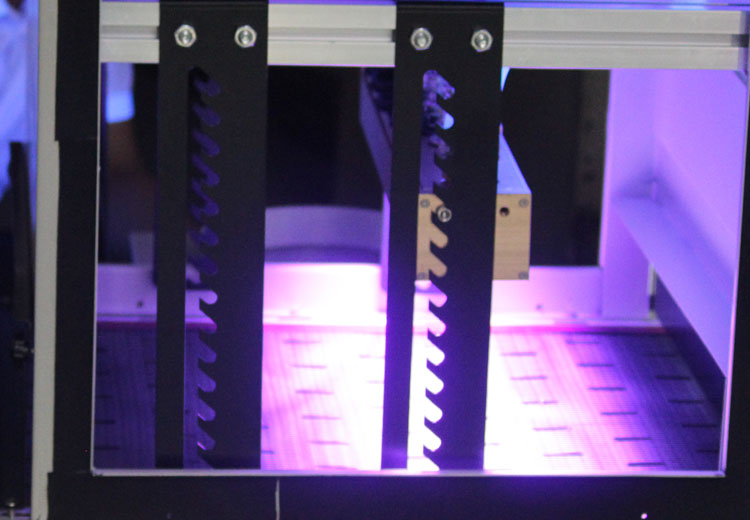
The core rule of UV curing is simple: under the same material and process conditions, higher LED UV energy levels greatly shorten curing time. High-power high-energy LED UV curing lamps release dense and concentrated ultraviolet photons in an instant. These sufficient photons quickly activate the photoinitiators in UV materials, triggering rapid molecular cross-linking reactions. For conventional screen printing UV ink and thin-layer UV adhesive, high-energy LED UV lamps can achieve full curing in 1 second, perfectly matching the high-speed operation of automated conveyor lines.
In contrast, low-energy LED UV curing lamps require a much longer irradiation time to reach the standard curing dose. If the energy intensity is insufficient, even with prolonged exposure, the UV material cannot obtain enough photon energy to complete thorough curing. This leads to typical problems such as surface dry but internal sticky, weak adhesion, and easy peeling of coatings. For mass industrial production, low-energy lamps force manufacturers to reduce conveyor line speed, severely limiting production capacity and increasing time costs.
However, blindly pursuing ultra-high energy and ultra-fast curing is not advisable. Excessively high UV energy with extremely short curing time will cause premature surface curing of UV materials. The surface layer hardens instantly to form a dense film, blocking the penetration of subsequent UV light, resulting in incomplete internal curing. This unbalanced curing condition will cause product deformation, ink yellowing, and reduced service life. Therefore, high-quality LED UV curing lamp supports adjustable energy output, helping factories match the most suitable energy level and curing time according to material thickness and formula.
Different industrial materials have strict matching requirements for UV energy and curing time. Thin-layer UV ink for screen printing adapts to high-energy and ultra-fast 1-second curing; medium-thickness UV adhesive for electronic bonding requires moderate energy and a slightly longer irradiation time to ensure deep curing; thick coating materials need graded energy output and reasonable time allocation to avoid surface aging and internal uncured defects.
Compared with traditional mercury lamp curing equipment, modern LED UV curing lamps have unique advantages in energy and time matching. Mercury lamps require long preheating time, unstable energy output, and cannot adjust energy flexibly. While LED UV lamps feature instant start, stable high-energy output, and flexible energy adjustment. They can precisely control curing time according to production line speed, realizing consistent, standardized curing effects in batch production.
In addition to improving curing quality and efficiency, reasonable matching of LED UV energy and curing time also brings significant cost-saving and environmental benefits. Appropriate high-energy fast curing eliminates repeated curing operations, reduces defective rates, and saves raw material costs. Meanwhile, LED UV lamps feature low power consumption, zero ozone emission, and no thermal radiation loss. Optimized energy and time parameters further reduce invalid power consumption, helping enterprises achieve energy-saving, efficient, and green production.
To sum up, energy level and curing time are interdependent and indispensable core factors of UV curing. High-quality LED UV curing lamp with stable adjustable energy is the foundation of fast and uniform curing. Industrial manufacturers need to formulate targeted energy and time matching schemes according to actual production materials and line speed, so as to maximize production efficiency, stabilize product quality, and enhance market competitiveness.