How Water-Cooled LED UV Curing Solved Acrylic Thermal Deformation and Doubled Screen Printing Output
News 2026-11-24
In high-precision acrylic (PMMA) screen printing, traditional high-pressure mercury lamps often cause severe sheet warping and incomplete curing of thick white ink layers. Discover how upgrading to a 395nm water-cooled LED UV curing system (Model: YJT-CT3-440A) lowered substrate temperatures below 45°C, boosted cross-hatch adhesion to 4B–5B, and doubled production line capacity from 800 to 1,600 sheets/hour.
Project Overview & Production Line Specifications
| Project Parameter | Details & Specifications |
|---|---|
| Client Location | Foshan, Guangdong, China (Pearl River Delta Manufacturing Hub) |
| Facility Scale | ~50 Employees (Contact: Mr. Zhang, Factory Owner) |
| Core Products | Acrylic signs, industrial equipment nameplates, mall wayfinding plaques, advertising displays |
| Substrate Material | Transparent & white PMMA (Acrylic) sheets, 2–5 mm thickness |
| Ink Type | UV screen printing ink (White, Black, Color), 395nm UVA absorption peak |
| Production Workflow | Acrylic Cutting → Semi-Auto UV Screen Printing → Inline UV Curing → Unloading & QC |
| Pre-Retrofit Equipment | Conventional high-pressure mercury UV lamp + conveyor tunnel |
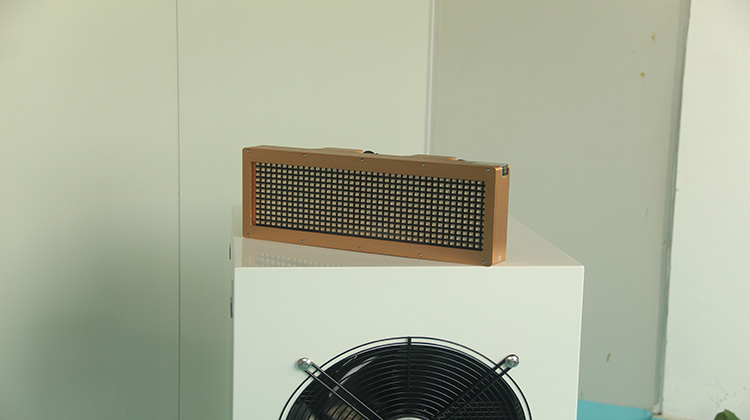
| Upgraded Solution | YJT-CT3-440A Water-Cooled LED UV Curing Lamp (395nm, 440mm custom emitting width) |
| Throughput Increase | 800 sheets/hr → 1,600 sheets/hr (+100% Capacity) |
| Project Lead Time | 2 working days for sample proofing; 5 working days for delivery & on-site commissioning |
1. Project Background & Pre-Retrofit Challenges
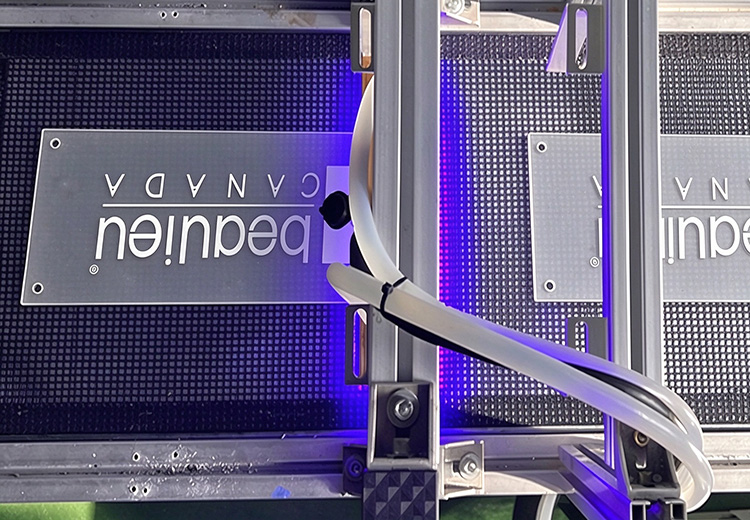
Located in Foshan—a major hub for signage and industrial manufacturing—Mr. Zhang’s 50-person factory specializes in UV screen printing on 2–5 mm PMMA (acrylic) sheets for commercial signage, medical/educational institutions, and equipment nameplates.
Prior to the upgrade, the factory relied on conventional mercury UV lamps paired with semi-automatic screen printers, which created five critical production bottlenecks:
- Severe Thermal Warping of PMMA Sheets: Acrylic has a low heat deflection temperature (HDT) of 70–80°C. Under mercury lamp IR radiation, sheet surface temperatures exceeded 90°C. Large signs (200 × 400 mm) warped by over 1 mm/m, causing dimensional rejects that accounted for more than 50% of total scrap.
- Incomplete Curing of Thick White Ink (15–20 μm): High-opacity white base layers cured on the surface while remaining uncured underneath (“surface-dry, inner-uncured”). Cross-hatch adhesion was rated at only Grade 1–2, causing ink to flake off during trimming and assembly.
- Frequent Downtime & Lamp Decay: Mercury bulbs required a 5-to-6-minute warm-up and degraded rapidly after 800–1,000 operating hours, interrupting continuous shifts.
- Ozone Emissions & High Exhaust Load: Mercury lamps generated strong ozone odors, forcing the workshop’s ventilation system to run at maximum load year-round.
2. Engineering Solution: 395nm Water-Cooled LED UV System
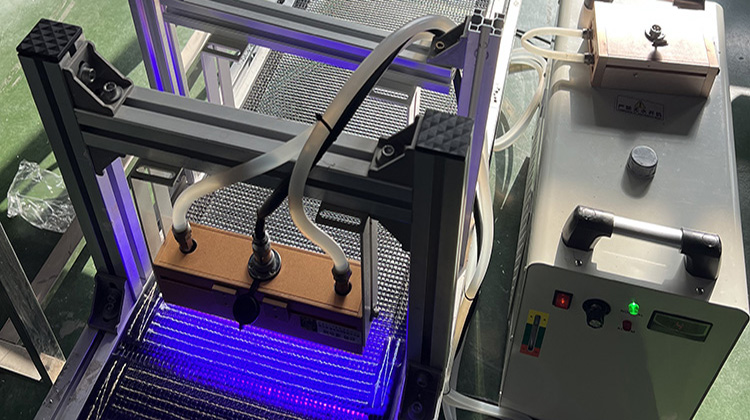
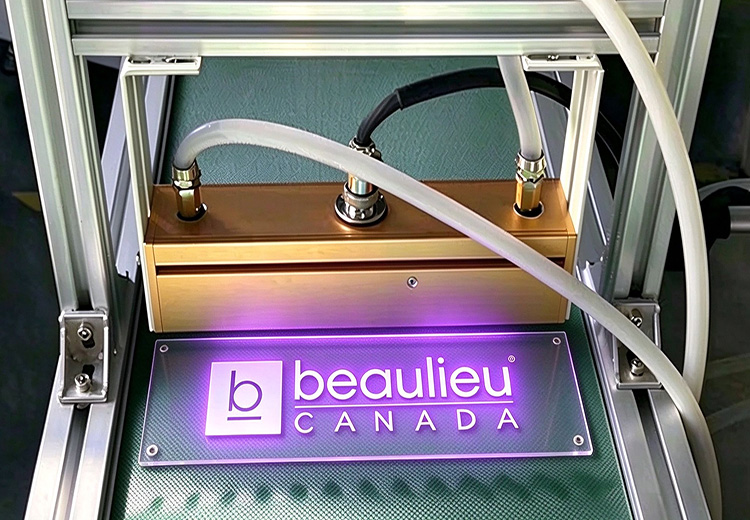
After analyzing the client’s PMMA thermal limits, ink photoinitiator absorption spectrum, and maximum print dimensions (200 × 400 mm), our engineering team deployed the YJT-CT3-440A Water-Cooled LED UV Curing Lamp:
- Precision 395nm Wavelength Matching: Tailored to match the exact photoinitiator peak of UV white and dark screen printing inks, ensuring deep penetration through 18 μm thick ink layers.
- Cold-Light Water Cooling Technology: High-efficiency water cooling dissipates heat away from the emitting head, keeping the acrylic surface temperature strictly between 38–45°C—well below PMMA’s 70°C deformation threshold.
- Custom 440mm Emitting Window: Designed to cover the full 200 × 400 mm sign format uniformly without edge drop-off, supporting simultaneous dual-station curing.
- 0–100% Stepless Power Control: Built-in 30% power headroom allows operators to fine-tune UV irradiance for heavy white ink coverage or fast color passes.
3. Side-by-Side Proofing & Lab Test Comparison
Before full deployment, we conducted a controlled comparison test using 3 mm white PMMA sheets and 18 μm wet-film UV white ink under identical workshop conditions.
| Test Parameter | Unit | Conventional Mercury Lamp | YJT-CT3-440A Water-Cooled LED UV | Test Standard / Method |
|---|---|---|---|---|
| Rated Power | W | 400 | 3,640 | Product Specification |
| Peak Irradiance | mW/cm² | 320 – 400 | 10,000 – 32,000 | UV Radiometer |
| Working Distance | mm | 120 – 180 | 50 – 80 | Production Line Setup |
| Curing Time (18 μm Ink) | s | 8 – 12 | 1.5 – 2.5 | Tack-Free Visual & Touch Check |
| Warm-Up Time | s | 300 – 360 | 0 (Instant On/Off) | On-Site Line Record |
| Curing Energy Dose | mJ/cm² | 600 – 700 | 250 – 300 | UV Radiometer |
| Cross-Hatch Adhesion | Grade | 1 – 2 | 4B – 5B | ASTM D3359 |
| Blade Scratch Test | — | Peels off in sheets | No peeling or flaking | Utility Blade at 45° Angle |
| Pencil Hardness | H | B – HB | H – 2H | Pencil Hardness Tester |
| Sheet Warpage (300×400mm) | mm/m | 0.8 – 1.5 | 0.1 – 0.2 | Surface Feeler Gauge |
| Sheet Surface Temp. | °C | 85 – 95 | 38 – 45 | Infrared Thermometer |
| Overall Defect Rate | % | 10% – 15% | 1.0% – 2.0% | 2,000 Consecutive Sheets |
| Line Output Capacity | sheets/hr | 800 | 1,600 | On-Line Production Count |
Reliability Verification: Samples also passed a 4-hour thermal aging test at 60°C with zero loss in cross-hatch adhesion.
4. Implementation & Quantified Production Results
Following sample approval, our technicians completed on-site wiring, conveyor integration, and operator training (covering daily water-chiller maintenance and quartz window cleaning). Backed by a 2-year full-system warranty, the upgraded line delivered immediate ROI:
- Near-Zero Thermal Warping: Sheet surface temperatures dropped by ~50°C, reducing warpage to 0.1–0.2 mm/m (exceeding the client’s ≤0.3 mm/m acceptance standard).
- Superior Ink Durability: Thick 18 μm white ink cured completely from top to bottom, achieving 4B–5B adhesion and H–2H pencil hardness.
- 100% Capacity Increase: Curing time dropped from 10 seconds to ~2 seconds, doubling line speed from 800 to 1,600 sheets/hour.
- 2,500 Fewer Scrapped Sheets/Month: Overall defect rates plunged from 10–15% down to 1.0–2.0%. At a monthly volume of 30,000 signs, the factory saves roughly 2,500 acrylic boards every month.
- 75% Energy Savings & 20,000+ Hour Lifespan: Instant on/off switching eliminates idle power draw during order changeovers, while the LED array lasts 20,000–30,000 hours without bulb replacements.
- Zero-Ozone Workshop Environment: Completely eliminated ozone generation, improving operator comfort and lowering exhaust electricity costs.
Frequently Asked Questions (FAQ)
Why does PMMA (acrylic) warp under traditional UV mercury lamps?
PMMA has a low heat deflection temperature of 70–80°C. Traditional mercury lamps emit heavy infrared (IR) heat alongside UV light, heating the acrylic surface above 90°C and causing dimensional warping. Water-cooled LED UV systems emit narrow-band 395nm UV light without IR radiation, keeping the substrate below 45°C.
Can 395nm LED UV cure thick white screen printing ink completely?
Yes. While white pigment (titanium dioxide) reflects shorter UV wavelengths, 395nm UVA light penetrates deeper into 15–20 μm white ink films. Paired with high peak irradiance (up to 32,000 mW/cm²), it achieves full through-curing and 4B–5B cross-hatch adhesion.
Request Free Sample Curing & Lab Testing
Experiencing sheet warping, thick-ink under-curing, or adhesion failures on your screen printing line? Send us your substrates and UV inks for free sample testing. We provide a complete lab verification report with measured irradiance, temperature, and adhesion data, plus custom fixture design.