Case Study: Achieving Deep Cure with Water-Cooled 395nm UV LED Technology
News 2026-11-11
The Client and the Challenge
Client: Apex Precision Components (name changed for privacy), a contract manufacturer specializing in high-reliability industrial sensors and automotive electronics.
The Problem: Apex recently launched a new line of sensors that required potting and bonding with a thick layer of UV-curable epoxy. Their existing traditional UV mercury lamp system was struggling. Because the adhesive layer was thick and heavily filled, the mercury lamps simply couldn’t deliver enough UV energy penetration. The top layer would skin over, but the bottom remained liquid.
Furthermore, the intense infrared heat from the mercury lamps was warping the delicate plastic sensor housings. Apex was experiencing a 15% scrap rate and was forced to run the conveyor line at an agonizingly slow speed to compensate.
The Solution: High-Power Water-Cooled UV LED System
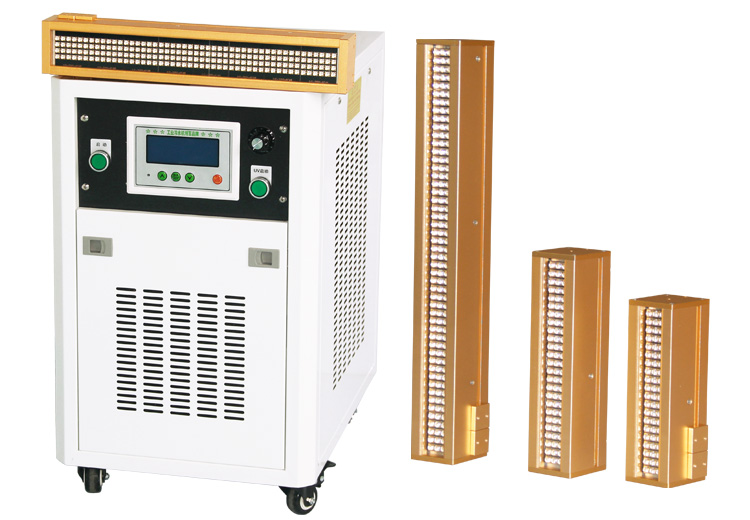
To solve this, our engineering team recommended replacing the mercury system with our high-intensity, water-cooled UV LED curing head, specifically configured for the 395nm wavelength.
Why 395nm? It provides deeper UV penetration through thick, filled adhesives compared to shorter wavelengths. More importantly, it generates significantly less heat, protecting the heat-sensitive sensor housings.
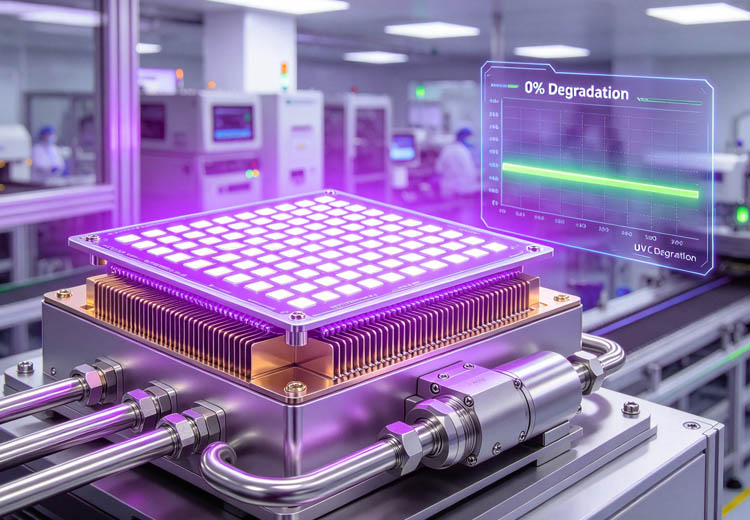
Why water-cooled? To achieve the extreme peak irradiance required for deep-cure, the LED chips run at high electrical currents. Our integrated water-cooling system extracts heat directly from the back of the copper LED array, ensuring the light output remains stable and prevents thermal degradation.
The system was seamlessly mounted over their existing mesh conveyor belt, allowing for continuous, automated production.
The Verification: Real-World Test Results
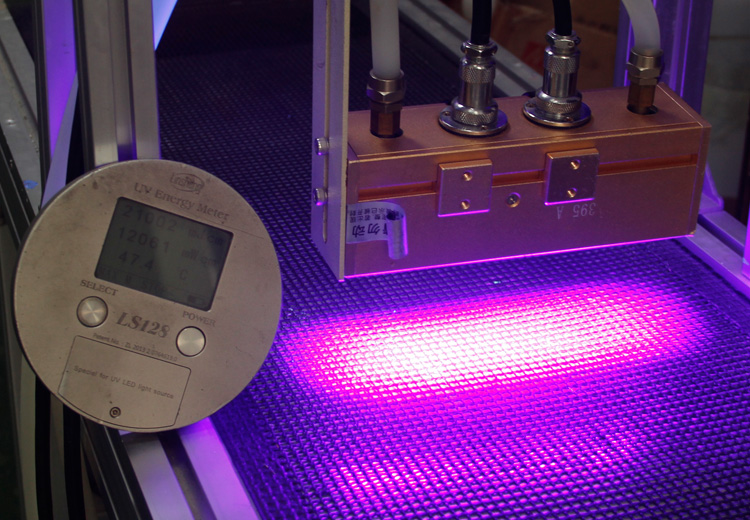
To prove the effectiveness of the new setup, we conducted a rigorous on-site test using an LS125 UV Energy Meter equipped with a 395nm sensor probe. The radiometer was placed directly on the mesh conveyor belt to measure the actual energy hitting the product.
As seen in the on-site photograph, the results were exceptional:
Wavelength: 395nm
Peak Irradiance (Power): Over 12,000 mW/cm² (12 W/cm²)
Total Energy Dose: 21,000 mJ/cm² (21 J/cm²)
(For reference, curing thick-layer industrial epoxies often requires a dose of 5,000 to 10,000 mJ/cm². Our system delivered more than double the required dose, guaranteeing a 100% cross-link cure.)
The Business Outcome
By switching to our water-cooled UV LED system, Apex Precision Components transformed their production line:
Zero Scrap: The massive UV energy dose penetrates the thick adhesive completely. Under-curing is a thing of the past.
Full Speed Ahead: Because the UV LED delivers intense power instantly, Apex was able to double their conveyor belt speed, maximizing their production capacity.
No Thermal Damage: The water-cooling design and 395nm wavelength eliminated the infrared heat, ending the warping issues on the plastic sensors.
Zero Downtime: The system runs continuously 24/7 with instant on/off capabilities, requiring no warm-up or cool-down periods.
High-intensity curing doesn’t have to come at the cost of thermal damage. With the right combination of 395nm wavelength, aggressive water-cooling, and uniform optical design, modern UV LED systems can handle the toughest deep-cure applications. As proven by the LS125 radiometer data, our system delivers the raw power needed to eliminate bottlenecks and guarantee product reliability.