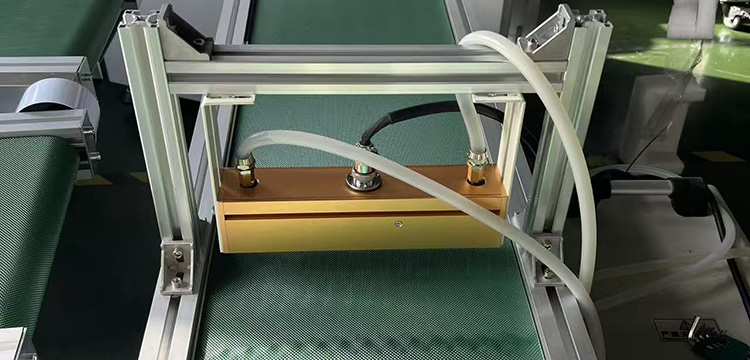
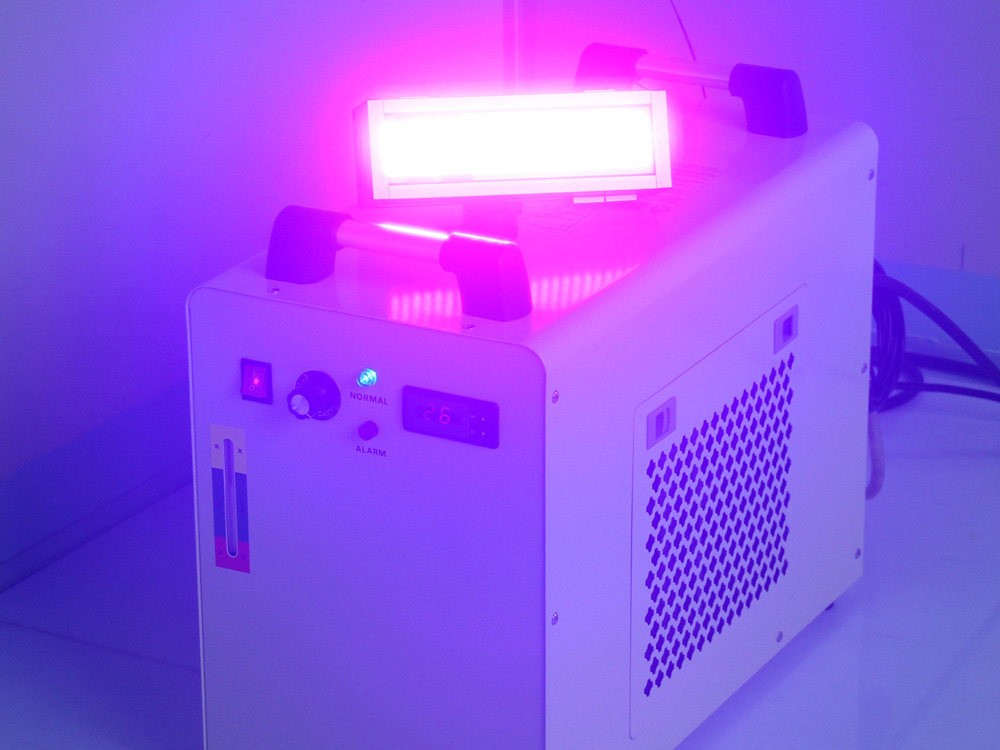
Can the 365nm and 405nm dual-band light source improve the deep curing effect of thick glass?
News 2025-12-27
For glass bonding with a thickness greater than 8mm, the 365nm and 405nm dual-band LED UV light source can break through the curing problem of a single wavelength. Through testing, the penetration depth of the 405nm band in glass is 40%-60% higher than that of 365nm, while 365nm has a better excitation efficiency for the photoinitiator of UV glue. When irradiated by a dual-band ultraviolet curing lamp, the curing speed of relatively thick UV glue is increased to 2.3 times that of a single-wavelength light source. However, it is difficult to balance the stability of the energy output of the curing lamp. Therefore, in the production of many products, attempts will be made to adjust the formula of the UV glue.
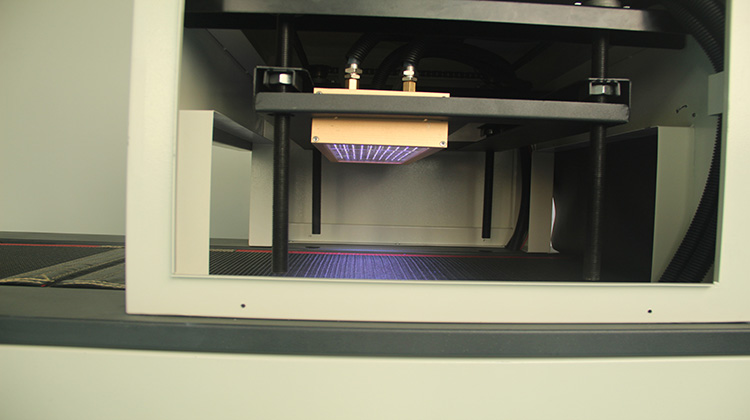
During the dispensing and curing process, the water-cooled LED UV curing machine can accurately adjust the power ratio of 365nm (mainly for surface curing) and 405nm (mainly for deep penetration) through a dual-channel wavelength independent control system. When an energy ratio of 1:1.5 is used, the interfacial shear strength of 8mm thick glass reaches 21.7MPa, an increase of 38% compared with single-wavelength curing. Tests show that dual-band irradiation reduces the standard deviation of the cross-linking density distribution of UV glue from 0.32 to 0.15, and the curing uniformity is increased by 53%.
In practical applications, it is necessary to match low-viscosity (<500cP) and high-refractive-index (1.52 – 1.55) UV glue, and adopt an atomizing dispensing process to increase the light transmittance of the adhesive layer. This solution has been successfully applied to the composite layer of bulletproof glass (12mm) and optical prism assembly. The curing time is controlled within 25 seconds, and no thermal stress cracks have occurred.