Application of LED UV Curing Lamps in Optical Lens Processing
News 2026-04-14
Lenses are widely used in various industries such as mobile phones, automobiles, medical treatment, security surveillance and instruments. Lens cementing is a critical process in lens assembly and production, and numerous lenses rely on LED UV curing lamps, which play a vital role in controlling and realizing the internal optical path of the lens. The quality of cemented lenses directly affects the optical performance of the lens.
The common lens cementing method is optical adhesive bonding, which achieves rapid cementing under ultraviolet light. Two or more lenses are usually cemented together: a convex lens and a concave lens with opposite R-values and the same outer diameter material are bonded with adhesive. First, the concave lens is placed on a cementing jig, and adhesive is applied via dispensing equipment or manually. Then the cementing surface of the convex lens is laminated with that of the concave lens.
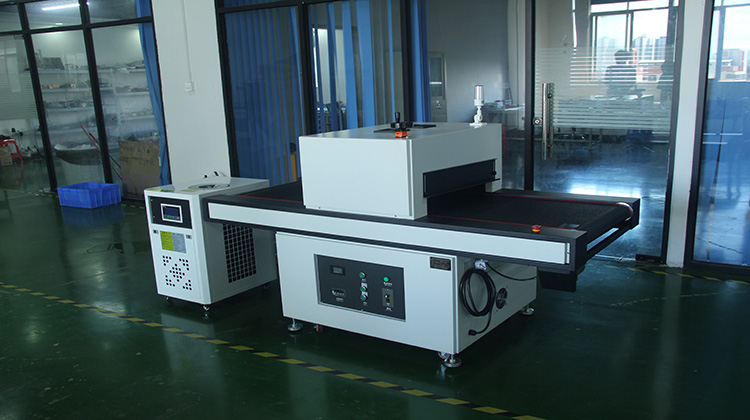
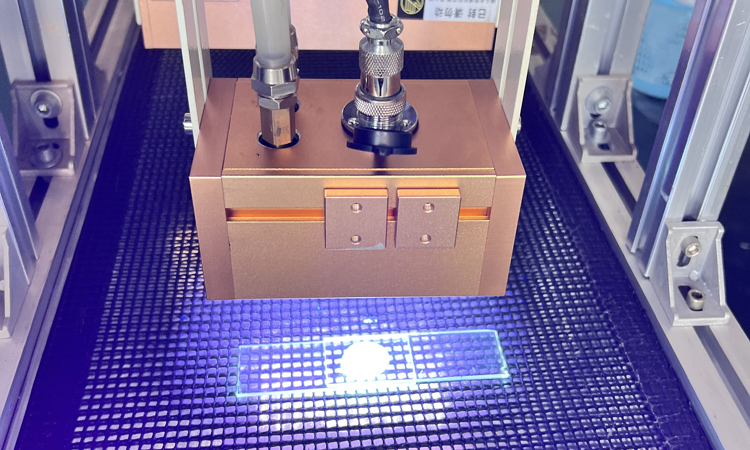
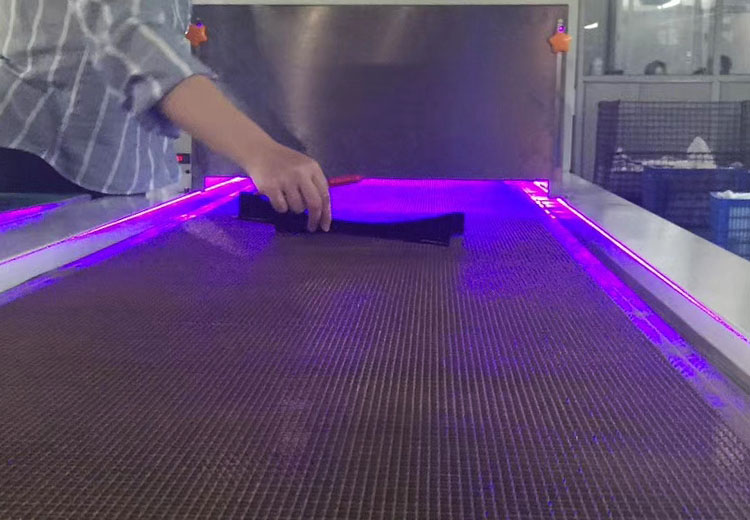
Before the UV adhesive is cured, the eccentricity of the lenses is inspected by optical testing instruments such as a lens centering tester, center instrument or aligner. After that, pre-curing is performed with strong UV irradiation from an LED UV point source. Finally, the assembly is placed in an LED UV curing oven (or an LED UV area light source can also be used), and exposed to weak ultraviolet light for a long time until the adhesive is fully cured, firmly bonding the two lenses together.
Previously, optical manufacturers typically used mercury lamp UV ovens for lens cementing. Today, to comply with environmental protection and energy-saving policies, most manufacturers have adopted LED UV curing light sources to improve yield rates and production efficiency. Compared with mercury lamps, LED UV light sources require no preheating, are ready for instant use, and can achieve the required UV power output immediately.
The curing oven is developed for high-demand curing applications in the optical field, such as slow curing (final curing) of cemented lenses and prism curing, as well as wafer photoresist curing in the semiconductor field. It features light uniformity of over 90%, a service life of up to 20,000 hours, low-temperature operation, energy saving and high-efficiency curing. It can be applied in optics, optical communication, semiconductors, microelectronics and other fields.