Effect of Distance Between LED UV Light Source and Substrate
News 2026-04-24
Hello everyone. Today we will share the effect of the distance between the LED UV light source and the substrate. Traditional mercury lamps produce a broad radiation spectrum with significant output in the ultraviolet region, especially in the UVC, UVB, UVA and UVV bands. This wide spectrum allows the selection of appropriate photoinitiators based on the light source type, intensity and formulation components, thereby optimizing the curing of acrylate-based inks, coatings, adhesives, sealants and composites to block or absorb ultraviolet light.
About 70% to 75% of the ultraviolet radiation emitted by these traditional low-pressure mercury lamps is ineffective for curing, accompanied by large amounts of high-energy infrared light that generate considerable heat. Typical mercury lamps require high-volume airflow to stay cool, resulting in additional energy consumption. Such high airflow rates make the use of inert gases to improve surface curing impractical, as expensive inert gas is continuously lost with the cooling air.
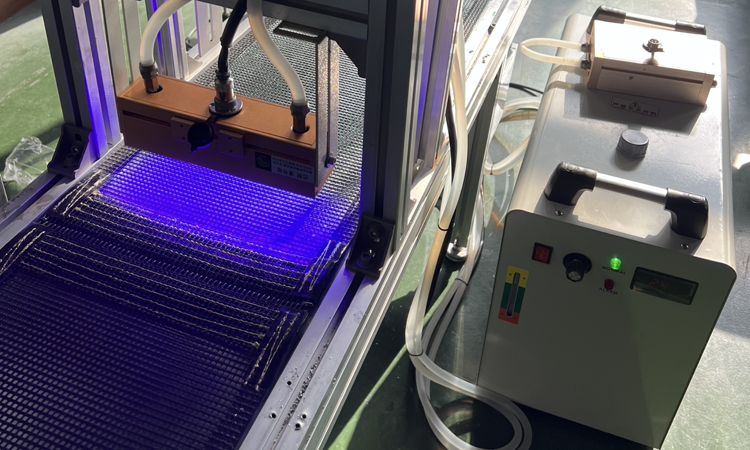
Over the past decade, significant progress has been made in generating high-intensity, high-flux ultraviolet light from light-emitting diodes. LED UV technology now serves many commercial applications, requiring less forced airflow and offering lower costs, making it widely applicable to heat-sensitive substrates and providing more economical UV curing performance.
(When water cooling is used in high-output systems >4 W/cm, energy savings are estimated at up to 50% compared with typical mercury lamp systems.)
Additional advantages include instant on/off operation with no warm-up time, enabling compact processes, and a much longer service life (20,000 hours vs. 2,000 hours).
LED UV light sources are characterized as non-focused systems. Tests were conducted to study the influence of source-to-substrate distance on reactivity, as inferred from reciprocal solvent rubs.
Differences were observed at distances between 4 and 8 millimeters from the substrate, but reactivity did not decrease further with longer distances. The improved curing at 4 mm may also be attributed to the higher temperature at this distance — 110°C, compared with 60°C at 8 mm. Closer distances could not be achieved due to grid constraints.
Other parameters considered included the effect of film thickness/mass and stabilizers on the reaction. Coatings ranging from 6 to 80 micrometers in thickness were tested, and showed nearly no difference in curing. One explanation may be that the high photoinitiator concentration required for full cure and the strong penetration of 395 nm light overcome the surface cure inhibition common in conventional systems. Films thinner than 6 micrometers exhibited poor surface curing. In-can stabilizers up to 4% were tested in clear coating formulations and found to have no effect on cure speed.