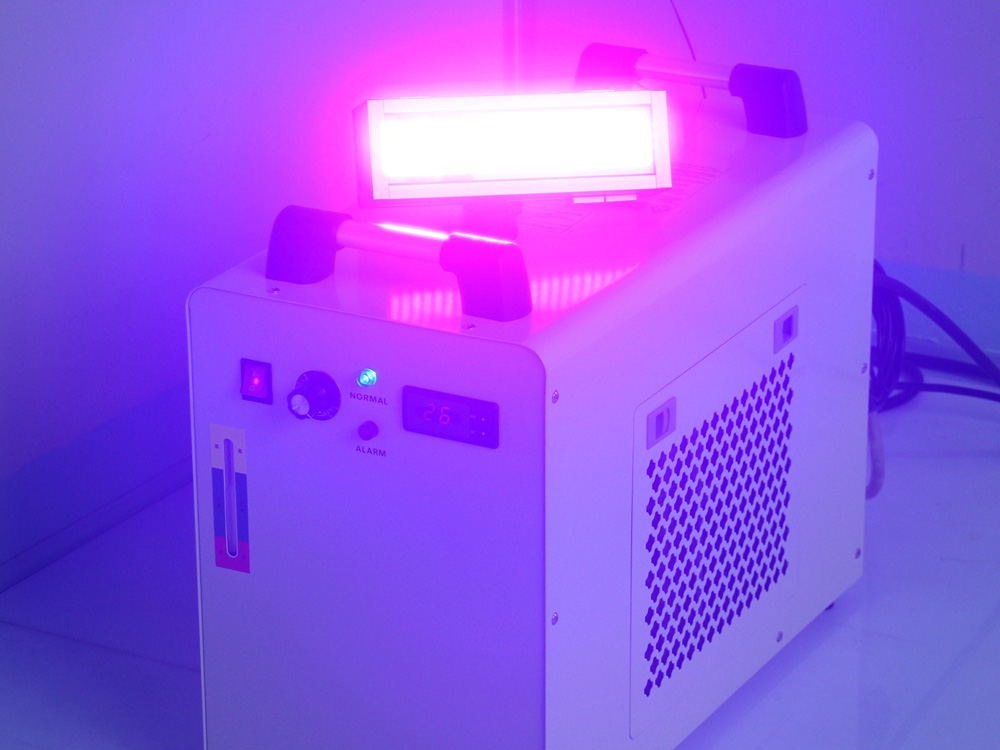
Plastic Parts Screen Printing Case Study: Water-Cooled LED UV Curing Retrofit Eliminates Warpage and Doubles Output
News 2026-11-25
Summary: By replacing traditional high-pressure mercury lamps with the YJT-CT2-320A 395nm Water-Cooled LED UV Curing System, a 100-employee plastic screen printing factory in Wenzhou reduced substrate surface temperatures from 110°C down to 38°C. This low-temperature curing retrofit eliminated thermal warpage on ABS/PC/PP parts, stabilized 3M tape ink adhesion at 100%, and increased production speed from 12 to 22 pieces per minute.
Project Overview & Technical Specifications
| Project Parameter | Details & Specifications |
|---|---|
| Client & Location | Plastic Parts Screen Printing Factory (Manager Lin) — Wenzhou, Zhejiang, China |
| Factory Scale | ~100 employees; multiple semi-automatic flatbed screen printing lines |
| Substrates & Thickness | ABS, PC, Acrylic, and PP plastic housings, panels, knobs, and signs (1.5–5.0 mm) |
| End-Use Industries | Consumer electronics, home appliances, automotive interiors, toys & gifts |
| Ink Type | Plastic-specific UV screen printing ink (absorption peak at 395 nm UVA) |
| Workshop Environment | Cleanroom: Constant temperature 22±2°C, humidity 55±10% RH |
| Upgraded Equipment | YJT-CT2-320A Water-Cooled LED UV Curing Lamp (395 nm wavelength) |
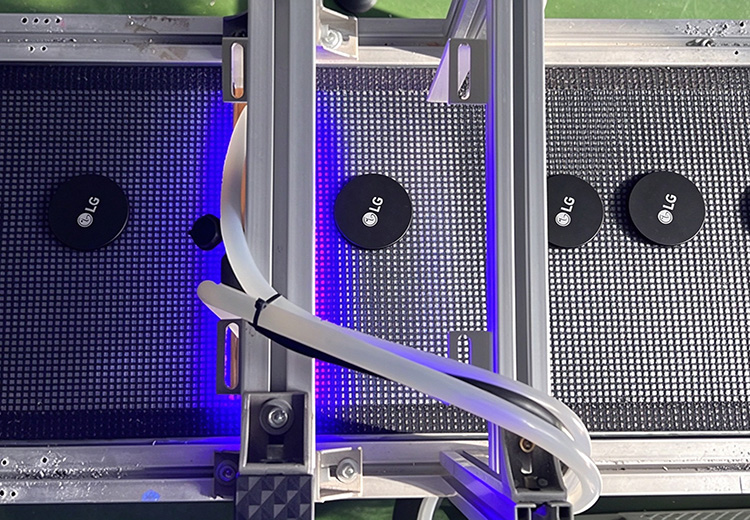
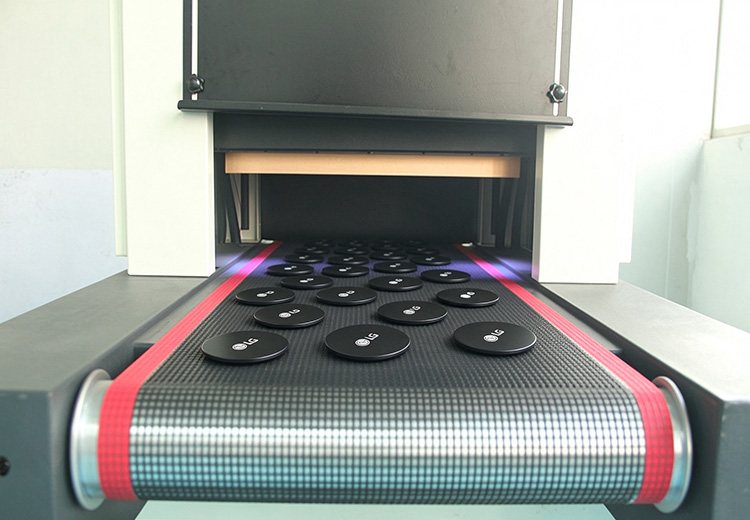
| Curing Area & Setup | Inline integration; customized light-emitting window matching 400×300 mm print area |
| Project Lead Time | 3 working days for sample testing; 7 working days for delivery & on-site commissioning |
1. Project Background & Production Bottlenecks
Located in Wenzhou—a major manufacturing hub for China’s plastics and printing industries—the client operates several semi-automatic flatbed screen printing lines. Their core workflow involves manual loading, flatbed UV screen printing, inline UV curing, unloading inspection, and packaging.
Previously, the factory relied on conventional high-pressure mercury lamps. Because common plastics like ABS and PP have a low Heat Deflection Temperature (HDT) of 85°C to 100°C, the intense infrared (IR) heat radiation from mercury lamps exceeding 100°C caused severe production bottlenecks:
- Severe Thermal Warpage & Discoloration: Thin-walled and large-surface ABS/PC housings warped, blistered, and yellowed under high heat. Out-of-tolerance assembly holes led to whole-part scrappage.
- Frequent Downtime for Fixture Realignment: Heat-induced bending shifted the positioning of irregular parts on jigs, forcing operators to halt lines for 20–30 minutes per adjustment.
- Inconsistent Ink Adhesion: Fluctuating mercury lamp temperatures caused uneven UV intensity. Ink adhesion failed intermittently during 3M tape peel tests, triggering batch rejections and customer complaints.
- High Maintenance & Ozone Hazards: Mercury bulbs degraded every 800–1,000 hours, disrupting continuous runs. Additionally, strong ozone emissions strained the cleanroom’s HVAC and exhaust systems.
The Client’s Core Goal: Transition to a true “cold light source” UV curing system that keeps plastic substrate temperatures well below their HDT while ensuring 100% consistent ink adhesion at higher line speeds (≥20 pcs/min).
2. Engineering Solution: 395nm Water-Cooled LED UV Retrofit
Following an on-site audit of the client’s flatbed printing lines, our engineering team engineered a custom retrofit utilizing the YJT-CT2-320A Water-Cooled LED UV Curing System:
- True Cold-Light Curing: Unlike mercury lamps, UV LEDs emit virtually zero infrared heat. Curing is driven purely by targeted UV photon energy, keeping substrate temperatures low and preventing thermal distortion.
- Precision 395nm Wavelength Matching: The 395 nm UVA output aligns directly with the photoinitiator absorption peak of the client’s plastic-specific UV inks, ensuring deep, rapid crosslinking.
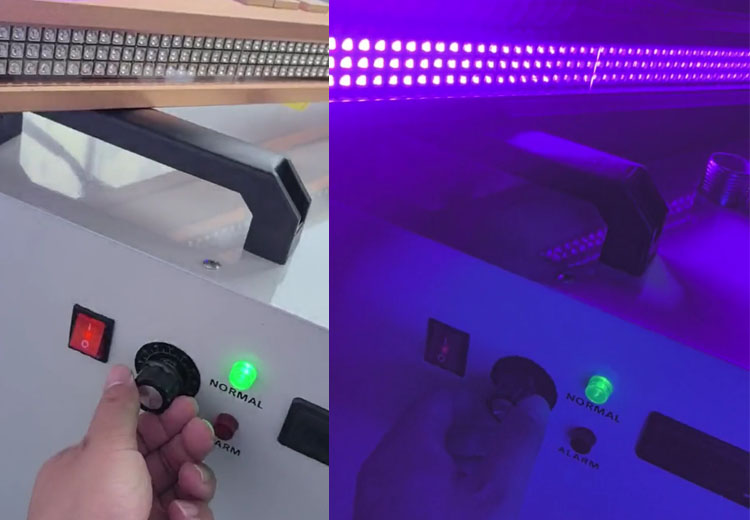
- Custom Optical Window & Power Margin: We customized a 320 mm wide planar light-emitting window to guarantee uniform irradiance across the entire 400×300 mm maximum print zone. Power is steplessly adjustable (0–100%), with a 30% intensity reserve to accommodate varying ink colors and polymer grades.
- Closed-Loop Water Cooling: Integrated water cooling prevents thermal chip degradation, maintaining rock-solid UV output stability during 24/7 continuous operation.
3. On-Site Testing & Performance Comparison Data
Prior to full deployment, we conducted side-by-side trials on the client’s production floor using identical white ABS housings, white UV screen printing ink, and cleanroom conditions.
| Test Metric | Unit | Conventional Mercury Lamp | YJT-CT2-320A Water-Cooled LED UV | Testing Method / Standard |
|---|---|---|---|---|
| Rated Power | W | 400 | 650 | Equipment nameplate spec |
| Peak UV Irradiance | mW/cm² | 300 – 380 | 9,000 – 11,000 | Calibrated UV radiometer |
| Working Distance | mm | 100 – 150 | 40 – 60 | Production line setup |
| Curing Exposure Time | sec | 1.5 – 2.5 | 0.3 – 0.5 | Tack-free surface check |
| Warm-Up Time | sec | 300 – 360 | 0 (Instant On/Off) | On-site production log |
| Curing Energy Dose | mJ/cm² | 500 – 600 | 200 – 250 | Calibrated UV radiometer |
| Part Surface Temp | °C | 95 – 110 | 38 – 45 | Infrared thermometer |
| Part Warpage | mm | 0.8 – 1.5 | 0.1 – 0.2 | Digital caliper measurement |
| Surface Defects | — | Yellowing, blistering, whitening | Zero discoloration or blistering | Visual QC inspection |
| 3M Tape Peel Failure | % | 5% – 12% (Unstable) | 0% (100% Pass) | 3M 610 tape (20 points/part) |
| TABER Abrasion | cycles | 150 – 250 | 500 – 700 | 500g load / CS-10F wheel |
| Thin-Wall Stability | — | Warps & shifts off fixture | Flat & dimensionally stable | 2-hour continuous run test |
| Overall Defect Rate | % | 6.0% – 10.0% | 0.5% – 1.0% | 50,000-piece production run |
| Line Throughput | pcs/min | 12 | 22 | On-line cycle counter |
(Note: The cured samples also passed 500g load alcohol rub resistance tests with zero ink degradation.)
4. Implementation & Measurable ROI Results
Once sample testing verified dimensional stability and ink durability across ABS, PC, acrylic, and PP parts, we manufactured the custom lamp head and completed on-site installation, wiring, and operator training within 7 working days. Backed by a 2-year comprehensive warranty, the upgraded line delivered immediate financial and operational returns:
- 90% Reduction in Thermal Warpage: Substrate surface temperature dropped from 95–110°C to a safe 38–45°C, shrinking warpage from 0.8–1.5 mm down to 0.1–0.2 mm.
- 15,000 Fewer Scrapped Parts Monthly: Overall printing defect rates plunged from 6–10% to 0.5–1.0%. Based on a monthly output of 200,000 units, the factory saves roughly 15,000 plastic parts per month from being scrapped.
- 83% Increase in Line Speed: Instant on/off switching and 0.3-second curing boosted line throughput from 12 pcs/min to 22 pcs/min, nearly doubling capacity without adding floor space.
- 100% Ink Adhesion Reliability: High peak irradiance (up to 11,000 mW/cm²) eliminated batch-to-batch curing fluctuations, achieving a 100% pass rate on 3M 610 tape tests and more than doubling TABER abrasion resistance.
- 75% Energy Savings & Zero Bulb Replacements: Power consumption dropped by approximately 75% compared to mercury systems. With a 20,000 to 30,000-hour LED lifespan, the factory eliminated recurring bulb purchases and change-out downtime.
- Ozone-Free Cleanroom Operation: Eliminating mercury lamps removed toxic ozone generation, improving operator comfort and reducing cleanroom exhaust loads.
Free Sample Curing Test & Custom Engineering
Are thermal deformation, yellowing, or inconsistent ink adhesion holding back your plastic screen printing lines? Send us your plastic substrates and UV inks for a complimentary curing evaluation. Our lab will provide a comprehensive test report with measured irradiance, temperature, and adhesion data, alongside custom fixture and optical window recommendations.