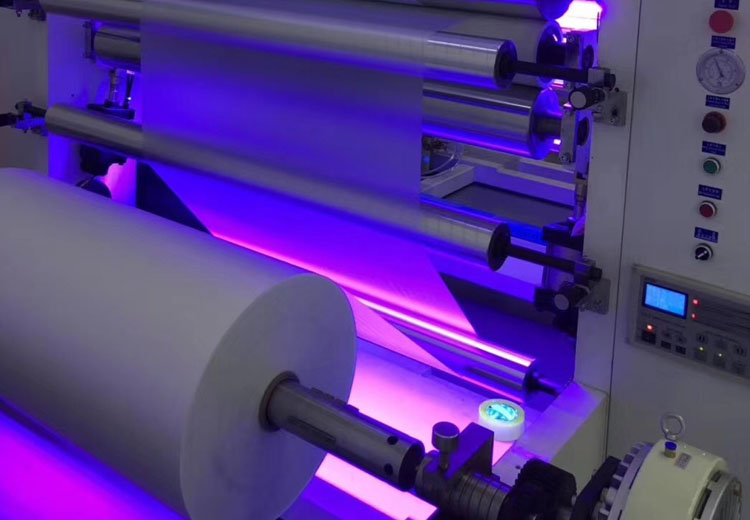
LEDUV surface light source: a new choice for rapid curing of silk-screened plastic on 350-mesh screen plates in assembly lines
News 2026-05-07
In the plastic product screen printing industry, 350-mesh screen plates are commonly used tools for printing fine patterns. UV ink screen printing for products such as mobile phone casings, home appliance buttons, and plastic signage is basically inseparable from them. The ink layer printed by a 350-mesh screen plate is thin and uniform, with a thickness of approximately 8-12μm, which can meet the appearance and usage requirements of most plastic products. However, traditional curing methods are inefficient and problematic. Nowadays, the emergence of LEDUV curing lamp surface light sources has perfectly solved these problems and become the mainstream choice for rapid curing on the assembly line.
Traditional production lines often utilize high-pressure mercury lamps for curing, but their drawbacks are evident. Mercury lamps require a 5-10 minute preheating period, and they must cool down before being restarted after being turned off, making it impossible to coordinate with continuous assembly line operations. They generate a large amount of heat, with the surface temperature of the product reaching 60-90℃. Plastic materials are prone to heat deformation and yellowing of the ink layer, resulting in a consistently low yield rate. Furthermore, mercury lamps have a lifespan of only 1000-2000 hours, requiring frequent replacement of the lamp tube, which is both troublesome and costly to maintain. They also produce ozone during operation, polluting the environment.
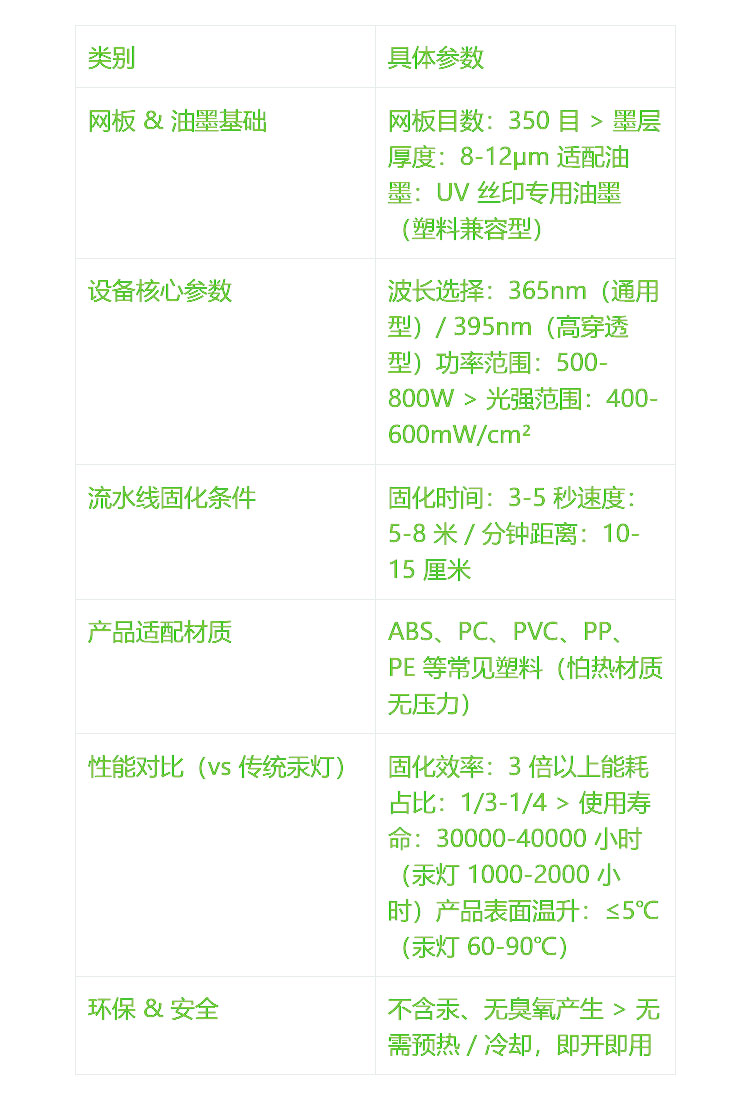
The LED UV surface light source is specifically designed for screen printing on plastic with a 350-mesh screen, offering particularly prominent advantages. It is a cold light source that can be used immediately upon power-up, without the need for preheating, and can instantly reach its maximum light intensity, fully adapting to the continuous production pace of the assembly line. During curing, the surface temperature of the product only rises by about 5°C, ensuring that heat-sensitive plastics such as ABS, PC, and PVC do not deform or warp. The ink layer has stronger adhesion, and better resistance to friction and alcohol wiping.
In terms of curing efficiency, the data speaks for itself. For UV ink screen-printed on a 350-mesh screen, using an LEDUV surface light source (wavelength 365nm or 395nm, power 500-800W), the curing time is only 3-5 seconds, and the conveyor belt speed can reach 5-8 meters per minute, with a curing efficiency more than three times that of mercury lamps. For the same ink cured by mercury lamps, it takes 10-20 seconds and requires temperature control to avoid issues. In terms of energy consumption, the LEDUV surface light source consumes only 1/3-1/4 of the power of a mercury lamp. Assuming an 8-hour workday, a single device can save tens of thousands of yuan in electricity bills annually. Its service life can reach 30,000-40,000 hours, with almost no maintenance required, making it particularly cost-effective for long-term use.
In practical production, the installation and operation of LED UV surface light sources are straightforward. They emit light in a planar manner, providing uniform illumination that can cover the entire screen printing area. The ink in the tiny holes of a 350-mesh screen can be thoroughly cured, eliminating the issues of partial drying or tackiness. The equipment can be directly integrated into existing production lines without requiring major modifications. By adjusting the irradiation distance to 10-15 centimeters and the light intensity to 400-600mW/cm², optimal curing effects can be achieved. Furthermore, as they are mercury-free and do not produce ozone during operation, they meet environmental protection requirements, making the production workshop environment safer and workers more at ease during operation.
Nowadays, more and more plastic screen printing factories have replaced mercury lamps with LEDUV surface light sources. Whether it’s a small processing factory or a large-scale production line, using it to cure plastic products with 350-mesh screen printing can achieve efficiency improvement, cost reduction, and quality enhancement. It can be said that LEDUV surface light sources are slowly replacing traditional mercury lamps and becoming the preferred equipment for curing in plastic screen printing lines, also driving the entire screen printing industry towards high efficiency, energy saving, and environmental protection.