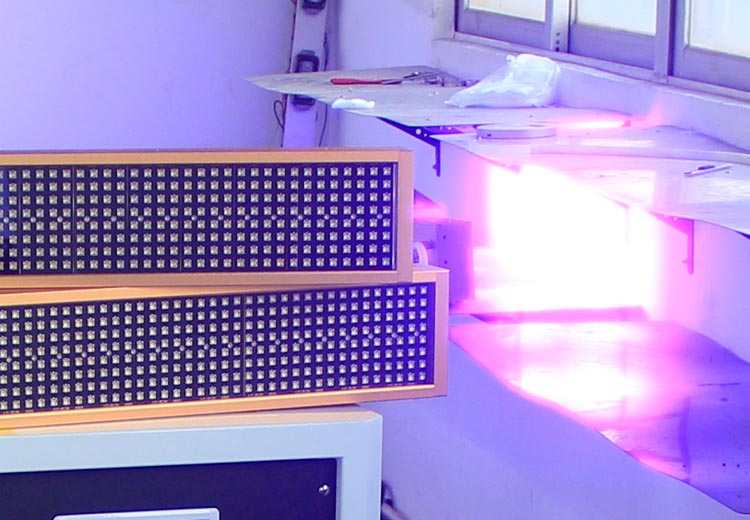
In the screen printing and curing of UV inks, utilizing a combination of LED UV curing lamps and mercury lamps can effectively resolve numerous curing challenges.
News 2026-05-15
In the UV ink screen printing industry, UV curing stands as the primary avenue for enhancing both production output and product quality. While traditional mercury lamp technology for curing UV inks is well-established, it suffers from high energy consumption and the emission of toxic and harmful gases, rendering it ill-suited to the current industrial demand for green and eco-friendly manufacturing. Consequently, LED UV curing lamps—with their advantages of energy efficiency, environmental friendliness, low-temperature operation, high efficiency, and ability to enhance ink layer texture—have begun to emerge as a trend poised to gradually displace traditional mercury lamp UV curing systems. However, despite the industry’s high optimism regarding LED UV curing products, they still possess certain limitations; for instance, they exhibit shortcomings when curing thick ink layers or specialized inks. Furthermore, in the context of curing substrates such as metal or glass—materials that are not susceptible to heat damage—LED UV lamps lose the distinct advantage offered by their low-temperature curing capabilities. As a result, in contemporary industrial manufacturing, an increasing number of factories are adopting a hybrid approach, utilizing both LED UV lamps and mercury lamps in tandem. This strategy creates a synergistic curing solution that leverages the complementary strengths of both technologies; while it may appear cumbersome at first glance, it effectively balances efficiency, quality, and cost, thereby establishing itself as the mainstream choice for UV ink screen printing curing.
1.Let us begin by objectively comparing and analyzing the core characteristics of these two types of curing lamps.
First, let us consider that LED UV curing lamps indeed possess the characteristics of a highly efficient and energy-saving “cold light source.”
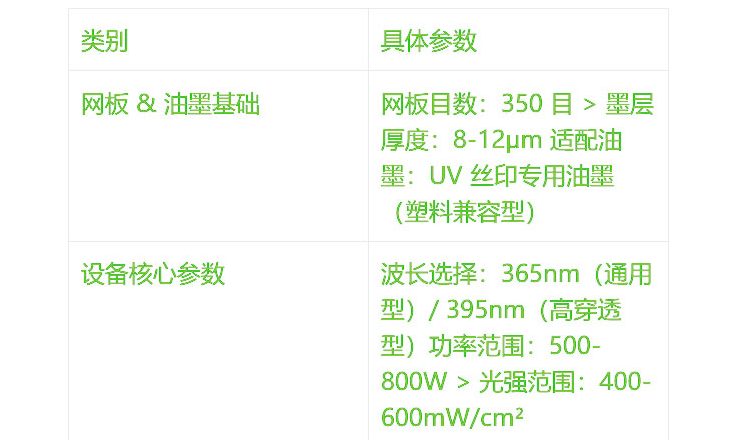
As LED UV lamps are semiconductor light-emitting devices, they emit ultraviolet light within specific, narrow wavebands—such as 365 nm and 395 nm—precisely matching the absorption peaks of photoinitiators found in UV inks. These lamps are ready for immediate use with no warm-up time required; curing can be completed in just 3 to 10 seconds, offering an ultraviolet curing efficiency more than three times that of traditional mercury lamps. During operation, the temperature rise of the workpiece is limited to approximately 5°C; the absence of thermal radiation prevents thermal deformation in plastics and precision components, as well as yellowing of the ink layer. Furthermore, LED UV curing lamps consume only 10% to 30% of the energy required by mercury lamps and boast a long service life of 20,000 to 50,000 hours. Being mercury-free and generating no ozone, they fully comply with green manufacturing standards.
Now, let’s take another look at the traditional mercury lamp—the “Big Brother” with the comprehensive spectrum—and see what it’s like.
As is well known, mercury lamps serve as traditional broad-spectrum UV light sources. Specifically, their spectral output spans a wide range of 200–450 nm, encompassing multiple distinct UV peaks—such as those at 254 nm and 365 nm—and offering robust deep-curing capabilities that ensure stable curing results for thick ink layers, metallic inks, and specialty-colored inks. However, they suffer from distinct disadvantages: mercury lamp tubes require a warm-up period of 1 to 5 minutes and a subsequent cool-down period after being switched off; they consume significant energy while in standby mode; and during active curing operations, they emit a substantial amount of UV radiation across wavelengths that are irrelevant to the actual curing process, thereby resulting in the unnecessary consumption of excess electrical energy. Typically, the surface temperature of the lamp rises to between 40°C and 90°C, which can easily lead to substrate deformation and the formation of bubbles within the ink layer. Furthermore, the operational lifespan of a mercury lamp tube is limited to a mere 800 to 1,000 hours; and because the tubes contain mercury vapor, they necessitate specialized waste disposal procedures—making environmental pollution and potential adverse effects on human health virtually unavoidable.
2.The combined use of LED UV curing lamps and mercury lamps for curing UV inks in screen printing constitutes a solution where 1 + 1 > 2.
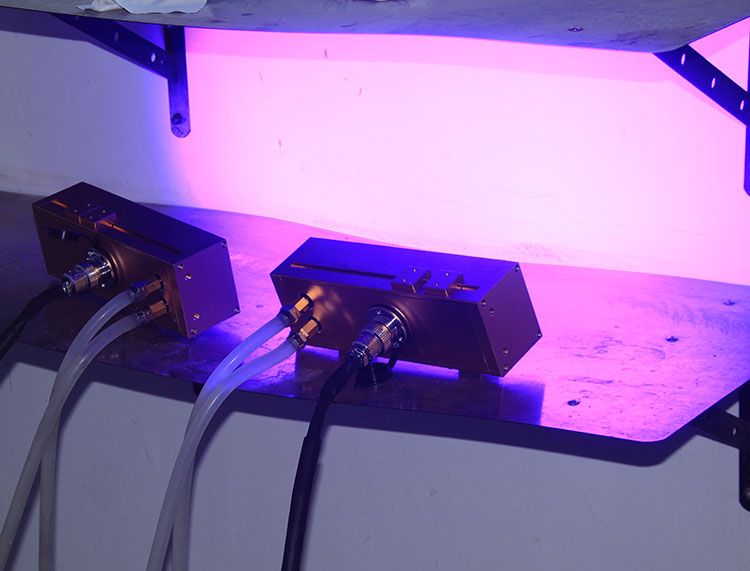
The combined use of water-cooled, cold-light-source LED UV curing lamps and mercury lamps for the curing of UV inks in screen printing can resolve 90% of current UV curing challenges.
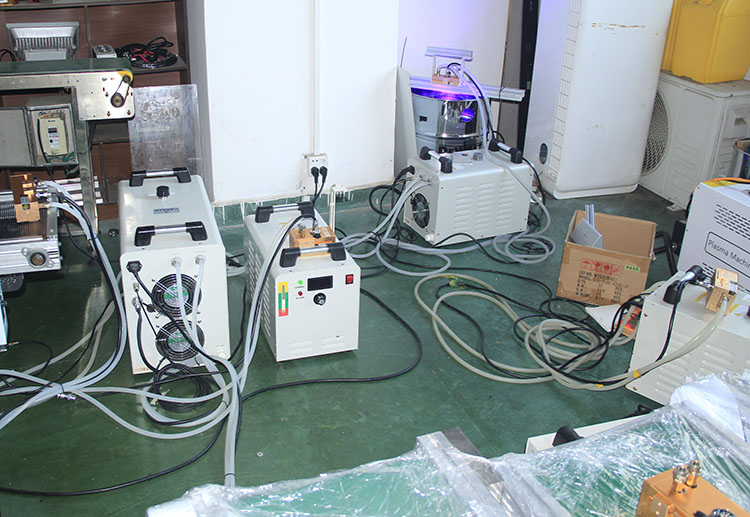
In complex screen printing production, a single light source often struggles to accommodate all requirements; consequently, the synergistic curing approach—combining LED UV and mercury lamps—has emerged to address this need. The core application scenarios are as follows:
When curing multi-layer or thick-layer UV inks, the surface layer is prone to over-curing, while the underlying layer suffers from insufficient curing. This issue is addressed by employing a process involving initial surface drying with LED-UV, followed by deep-layer curing using a mercury lamp.
The process involves using a 395nm LED UV curing lamp to rapidly cure the surface layer, thereby preventing dust adhesion and ink flow; subsequently, short-wave ultraviolet light from a mercury lamp penetrates the underlying layer to thoroughly cure any residual active groups, thereby preventing a decline in interlayer adhesion.
On production lines requiring the processing of mixed materials or multiple ink types—specifically when simultaneously handling substrates such as plastic, metal, and glass, or utilizing standard, metallic, and colored inks—LEDUV lamps are ideally suited for heat-sensitive materials and thin ink layers, while mercury lamps specialize in metallic inks and thick coatings. This flexible switching capability requires no equipment replacement, thereby significantly enhancing production compatibility.
Utilizing light curing in this manner actually represents a strategic balance between efficiency and cost-effectiveness. For high-volume, standard products, LED UV curing lamps are employed to achieve “instant drying”—thereby accelerating production and reducing costs. Conversely, for low-volume or technically complex products, mercury lamps are utilized to ensure superior quality. This dual-lamp configuration allows for on-demand activation, preventing a single light source from operating under full load for extended periods; this practice ultimately extends the overall service life of the equipment and lowers comprehensive operating costs.
3.The Practical Advantages of Using a Combination of LED UV Curing Lamps and Mercury Lamps for Curing During UV Ink Screen Printing
Enhanced Quality Stability: LED-UV technology ensures uniform surface curing and excellent gloss. Mercury lamps resolve the challenge of deep-layer curing, resulting in significantly improved ink adhesion, abrasion resistance, and chemical resistance, while drastically reducing the defect rate.
Substantial Efficiency Gains: By eliminating the lengthy warm-up period required for mercury lamps—and combining rapid LED-UV curing with deep post-curing via mercury lamps—production line speeds are boosted by 30% to 50%, making the system ideally suited for high-speed assembly line production.
Controllable Cost Optimization: LED-UV technology offers energy efficiency, power savings, and maintenance-free operation; furthermore, the targeted application of mercury lamps reduces replacement frequency. Consequently, the long-term comprehensive cost is reduced by 20%–40% compared to a solution relying solely on mercury lamps.
Green and Eco-compliant: Reduces the use of mercury lamps, thereby lowering mercury pollution and ozone emissions. LED UV technology operates at low temperatures, improving the workshop environment and ensuring compliance with RoHS standards and environmental policy requirements.
4.Important Considerations When Using a Combination of LED UV Curing Lamps and Mercury Lamps for Curing UV Ink During Screen Printing
Synergistic curing requires parameter adjustments based on specific product characteristics. For thin ink layers, the curing process relies primarily on illumination from LED-UV curing lamps, supplemented by mercury lamps. For thick ink layers or metallic inks, the power output of the mercury lamps or the irradiation time should be increased; in these cases, LED-UV curing lamps operating in the 365 nm and 395 nm wavebands are the preferred choice, as they exhibit a higher degree of spectral matching with the 365 nm peak emission of mercury lamps, thereby ensuring stable curing results.
Based on the above summary, it can be concluded that…
In the screen printing of UV inks, the combined use of LED UV curing lamps and mercury lamps addresses numerous curing challenges. This represents not merely a simple technical superposition, but rather an optimized and upgraded approach to the screen printing curing process. By leveraging the high efficiency, energy savings, low heat emission, and eco-friendly attributes of LED UV lamps—while simultaneously retaining the deep-curing capabilities and broad adaptability of mercury lamps—this method effectively resolves the application bottlenecks inherent in using a single light source. In the screen printing industry—which constantly strives for high quality, low costs, and eco-friendly production—this synergistic solution is poised to gain widespread adoption, thereby empowering manufacturing facilities to enhance their core competitiveness.