100% Cross-Link Cure: Achieving Pinhole-Free Adhesion and Stable Waterproof Ratings
News 2026-10-21
Introduction
In industries ranging from consumer electronics to automotive sensors and medical devices, a waterproof seal is a critical performance requirement. Yet, many manufacturers face a frustrating paradox: the adhesive appears fully cured to the naked eye, but the final product fails the water immersion or pressure test. The culprit is often invisible. It is the lack of a 100% cross-link cure and the presence of microscopic voids. Achieving a truly pinhole-free adhesive layer is the only way to guarantee a stable, long-term waterproof rating.
The Link Between Cross-Linking and Waterproofing
An adhesive acts as a barrier. To prevent water molecules from passing through, the polymer network must be dense and continuous. A 100% cross-link cure means that virtually all reactive monomers and oligomers have converted into a highly interconnected 3D polymer network.
Under-cured Zones: If the cure is incomplete, residual unreacted monomers act as plasticizers, weakening the bond and allowing water molecules to permeate the network over time.
Micro-Voids and Pinholes: These are microscopic gaps, air bubbles, or pathways within the adhesive. Even if the polymer network is dense, a single micro-void can act as a capillary, drawing moisture directly through the bond line and causing sudden waterproof failure.
Why Micro-Voids Form During Curing
Eliminating defects requires understanding their origins. Micro-voids and pinholes typically arise from three main sources:
Oxygen Inhibition: In free-radical UV curing systems, oxygen in the air reacts with free radicals, preventing the surface layer from fully curing. This leaves a tacky, porous surface that fails under water pressure.
Trapped Air and Outgassing: Bubbles introduced during mixing, dispensing, or from substrate outgassing can become trapped in the adhesive. If the curing process is too rapid, the adhesive skins over before these bubbles can escape, resulting in a pinhole.
Cure Shrinkage Stress: As the adhesive cross-links, it shrinks. Uneven curing (hot spots and shadows) causes uneven shrinkage, which creates internal stress and micro-cracks at the interface, leading to localized water ingress.
Strategies to Eliminate Pinholes and Micro-Voids
To achieve a pinhole-free bond, the curing process must be controlled with precision:
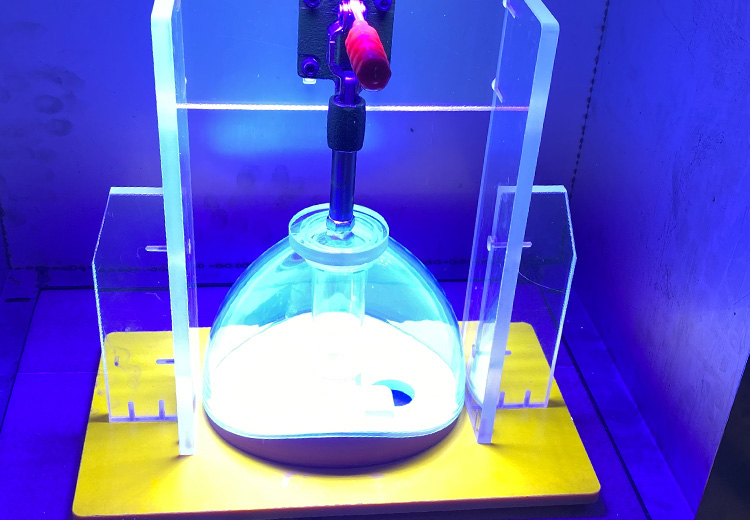
Inert Gas Purging (Nitrogen Blanketing): To overcome oxygen inhibition, cure the adhesive in a nitrogen-rich environment. This allows the surface to achieve a 100% cross-link cure, sealing off the adhesive from moisture.
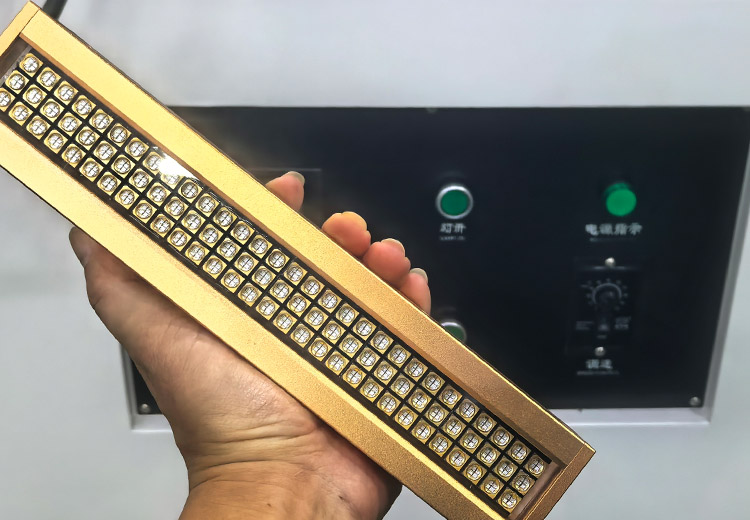
Optimized Light Uniformity: Uneven UV light creates uneven cure rates. A whole-surface uniform light field ensures that the entire adhesive layer cures simultaneously, minimizing internal stress and preventing localized under-cured zones that act as leak paths.
Controlled Ramp-Up Profiles: Instead of blasting the adhesive with maximum UV energy immediately, use a controlled, lower-intensity pre-gel phase. This allows trapped air bubbles to escape before the top surface is permanently sealed.
Dispensing Optimization: Ensure proper degassing of the adhesive before use and optimize the dispensing pattern to avoid introducing air.
Securing Stable Waterproof Ratings (IP67 / IP68)
A stable waterproof rating is not achieved by a single successful test, but by a repeatable process. To secure IP67 (immersion up to 1 meter) or IP68 (continuous immersion under pressure), manufacturers must ensure edge and corner cure is flawless.
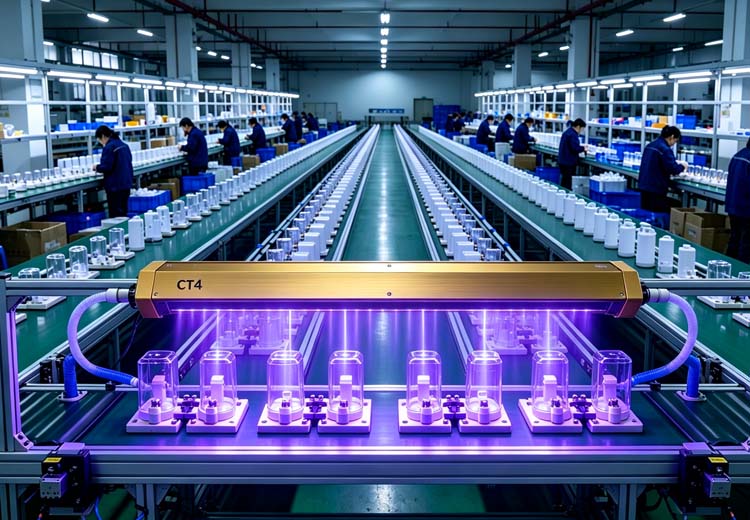
Water ingress often starts at the perimeter of the bond line. This requires the UV light to penetrate effectively to the edges of the joint. Reflector design and multi-angle exposure in the curing tunnel are critical. Furthermore, thermal management—such as the integrated water cooling seen in advanced curing systems—prevents the substrate from expanding and contracting excessively during the cure, which could otherwise compromise the seal.
Validation and Quality Control
Verifying a 100% cross-link cure requires more than a visual inspection.
FTIR Spectroscopy: Measure the conversion rate of the specific functional groups in the adhesive to confirm it has reached near 100% cross-linking.
Microscopy: Use cross-sectional optical or electron microscopy to inspect the bond line for micro-voids.
Helium Leak Detection: For high-reliability products, helium mass spectrometry can detect microscopic leak paths.
Environmental Aging: Test the waterproof rating after harsh conditions (e.g., temperature cycling or salt spray) to ensure the 100% cured adhesive remains stable.
Conclusion
A waterproof seal is only as strong as its weakest microscopic point. By prioritizing a 100% cross-link cure and engineering the process to eliminate micro-voids, manufacturers can move away from unpredictable waterproof failures. Through uniform light delivery, inert gas control, and rigorous validation, a pinhole-free adhesive layer becomes a standard, guaranteeing stable IP ratings and long-term product reliability.
Frequently Asked Questions (FAQ)
Q: What does a 100% cross-link cure mean in adhesives?
A: It means almost all reactive molecules have bonded into a dense polymer network. A fully cross-linked adhesive has maximum cohesive strength and the best barrier properties against moisture.
Q: How does oxygen inhibit the curing process?
A: Oxygen reacts with free radicals at the surface, stopping the polymerization process. This leaves a weak, uncured surface layer that can easily fail under water pressure. Using nitrogen purging or specific adhesives helps overcome this.
Q: Why does my waterproof test fail even if the glue feels dry?
A: The surface may be cured, but internal micro-voids (air bubbles) or under-cured zones at the edges can create pathways for water to seep through under pressure. Uniform illumination is required to cure the entire depth and footprint.
Q: How can I check if there are micro-voids in my adhesive?
A: Visual inspection is not enough. Use cross-sectional microscopy to inspect the bond line, or use non-destructive methods like ultrasonic scanning or helium leak detection.